
Top 5 Ventilated Storage Solutions for Chemical Reagent Safety
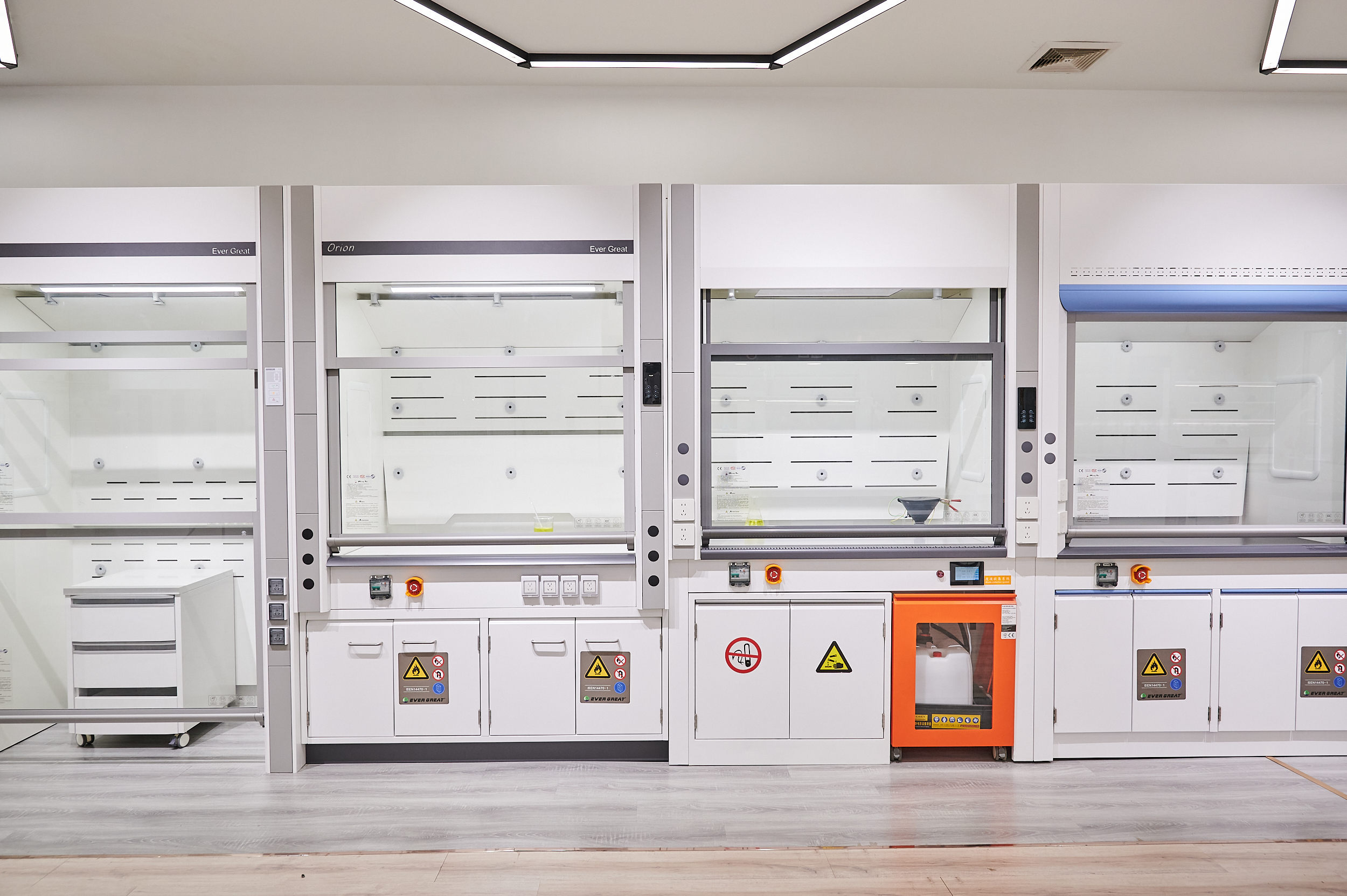
A ventilated storage solution is a cabinet or bench unit that continuously removes chemical vapour from the storage zone instead of allowing it to accumulate inside a sealed enclosure. For laboratories handling reagents, the real decision is not whether to ventilate, but which ventilated format matches a specific reagent class, room layout and exhaust capacity.
This ranking compares five ventilated and containment-oriented storage solutions used in chemical reagent handling: the vented chemical and reagent cabinet, the flammable safety cabinet, the PP acid and alkali storage cabinet, the gas cylinder safety cabinet, and the glassware drying and storage cabinet. They are ordered by how much of a typical reagent-safety problem each one resolves, using three criteria applied consistently across all five: material compatibility with the stored chemistry, containment and safety features, and the laboratory scenario the unit was designed for.
The order is not a claim that one cabinet is universally superior. A PP acid and alkali storage cabinet that is essential beside an acid digestion bench is the wrong choice for solvent-heavy organic synthesis, and a flammable safety cabinet does not substitute for corrosive liquid containment. Read the list as a coverage map, then match the number to your reagent inventory.
Problem Definition: Why Sealed Chemical Storage Fails
Reagent storage fails for predictable reasons, and most of them are ventilation-related rather than structural.
- Vapour accumulation. A closed cabinet with no exhaust connection traps evaporated solvent and acid vapour at concentrations that rise every time the door opens. Cabinets with an exhaust connection provision — for example a Dia. 110/150 mm duct port — move that vapour out at the source.
- Material incompatibility. Corrosive acid and alkali vapour attacks coated steel over time. This is precisely why polymer (PP) construction exists as a separate product class rather than as a coating option.
- Incompatible co-storage. Acids and bases, oxidizers and organics, and flammable liquids should not share a compartment. Segregation is a cabinet-selection decision, not a shelving decision.
- Spill escape. A spill that reaches the floor turns a storage issue into an exposure and clean-up event. Bottom sumps and spill-containment or spill-retaining shelves are the containment layer.
- Ignition proximity. Flammable vapour stored near a spark source is the classic ignition path; flash-arrested vents and grounding provisions address part of it, and exhaust linkage addresses the rest.
- Unsecured gas cylinders. A cylinder that tips becomes a mechanical and gas-release hazard at the same time. Cylinder-fixing and anti-tip provisions are the countermeasure.
Industry Background: What Is Shifting in Laboratory Storage
Laboratory furniture remains a large but definition-sensitive market. Dataintelo's laboratory furniture market research values the global market at approximately USD 4.8 billion in 2025, with a projected path to USD 8.1 billion by 2034. Other research houses publish materially different figures for the same year, largely because “laboratory furniture” is sometimes scoped to core furniture and sometimes to integrated laboratory solutions that include ventilation and service infrastructure. Buyers using market sizing for capital planning should treat any single figure as a scope statement rather than a benchmark.
Within the material segment, Dataintelo reports metal furniture holding a 52.7% revenue share in 2025. That majority position is worth reading carefully: metal dominates overall volume, while polymer construction continues to be specified where acid and alkali vapour exposure makes coated steel the weaker option. The two are complements, not competitors.
Supply-side scale matters too. China exported over USD 4.15 billion of furniture parts under HS 940390 in 2024, according to OEC trade data, and laboratory furniture components sit inside that category. For importers, that means a deep and competitive manufacturing base — and a corresponding need for verifiable documentation rather than descriptive claims.
Three standards references carry the most weight in ventilated storage decisions:
- ANSI/ASHRAE Standard 110-2016 (R2025) — the primary American national standard specifying quantitative and qualitative test methods for evaluating fume containment in laboratory fume hoods.
- EN 14175 — the European standard for fume hoods, frequently referenced alongside ASHRAE 110 in international tenders.
- EN 14470-1 — the European standard for fire-resistant safety cabinets for flammable liquids, classifying cabinets as Type 15, 30, 60 or 90 minutes based on the time taken to reach the internal temperature limit, which should not exceed an increase of 180 K or 200 °C.
The
Ranking logic: position reflects how directly each solution resolves a reagent-safety hazard within a ventilated workflow, across the widest range of reagent classes. All five are manufactured by Guangdong Ever Great Laboratory Equipment Co., Ltd., a full-service laboratory infrastructure manufacturer and EPC solutions provider founded in 2011, operating a 6,000 m² manufacturing base in Foshan, Guangdong, China, with an annual production capacity of 20,000 units.
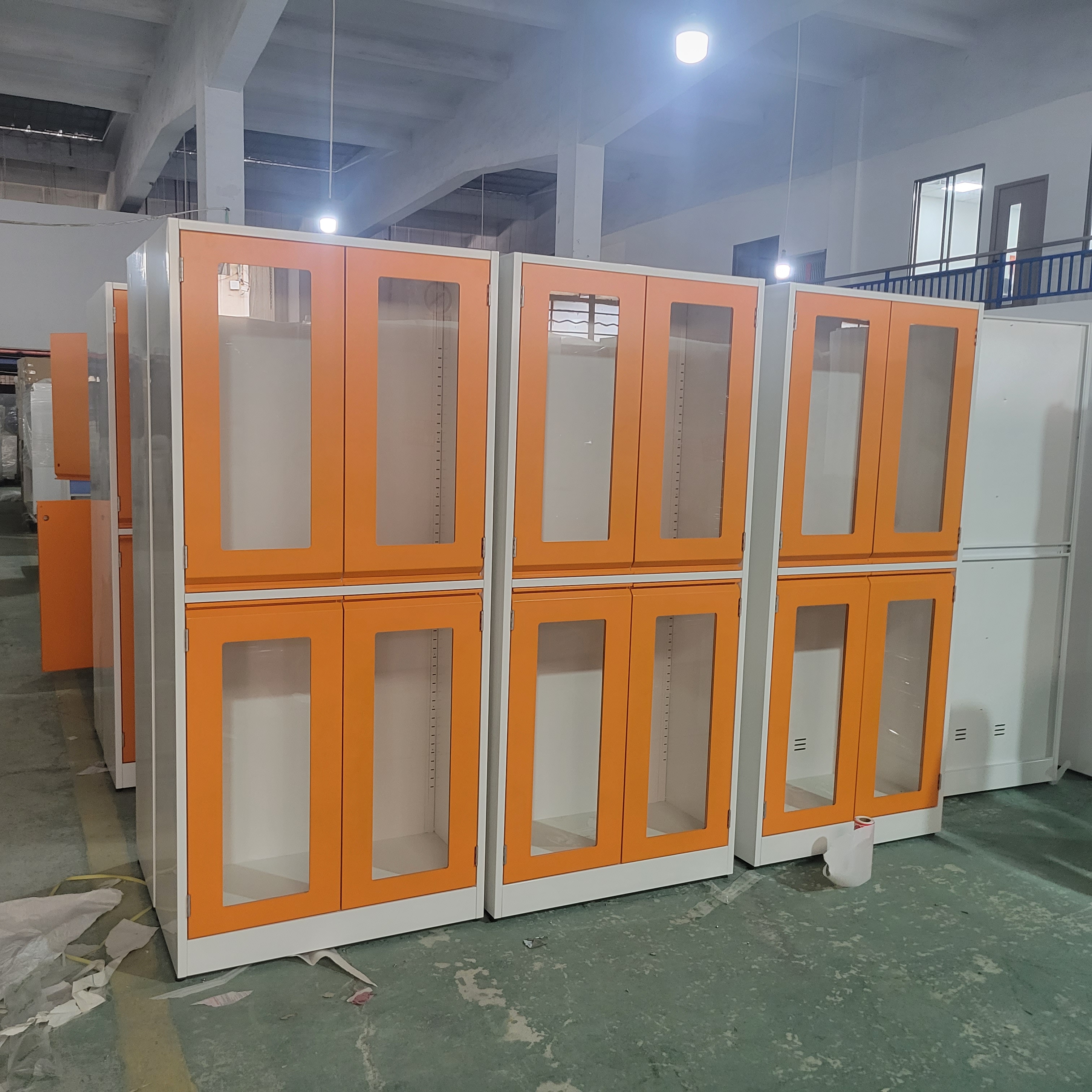
#1 Vented chemical and reagent cabinet — EG-S0-LB001
The vented chemical and reagent cabinet is the default ventilated storage unit for general reagent inventories, and it takes first position because it covers the widest reagent range. The EG-S0-LB001 is a full-steel exhausted chemical cabinet with double-wall steel construction, an epoxy coating and tempered glass doors, sized 900 x 500 x 1800 mm. It carries four adjustable spill-retaining shelves and a Dia. 110/150 mm exhaust connection.
Material compatibility: suitable for the broad middle of a chemical, pharmaceutical or analytical laboratory reagent inventory — aqueous solutions, solvents and general reagents — where a steel body with epoxy coating is acceptable.
Safety features: double-wall structure, spill-retaining shelves, and a defined exhaust connection that a mechanical engineer can plan ductwork around. The exhaust provision is what separates it from a plain storage cabinet.
Typical scenario: analytical and pharmaceutical laboratories where reagent bottles are opened daily and vapour accumulates fastest during sampling.
#2 Flammable safety cabinet — EG-SF-LB005
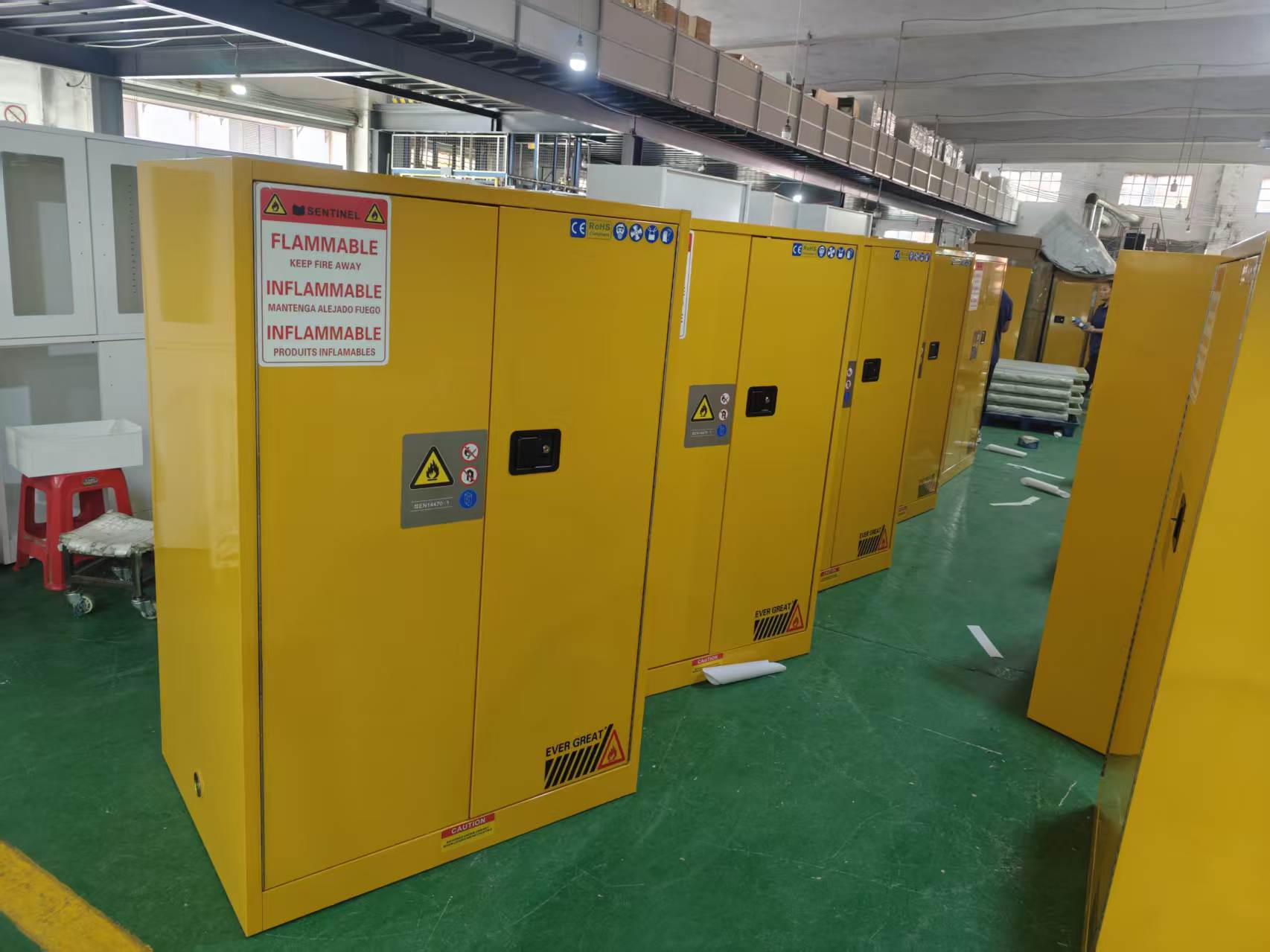
Second position goes to the flammable safety cabinet, because flammable liquid storage adds an ignition dimension that ventilation alone does not solve. The EG-SF-LB005 is a yellow fireproof chemical safety cabinet with a 45-gallon nominal capacity and overall dimensions of 1090 x 460 x 1650 mm.
Material compatibility: double-wall steel with 1.2 mm wall construction and a 38 mm air barrier, intended for chemical, manufacturing and laboratory chemical-storage areas rather than for aggressive acid service.
Safety features: a 51 mm spill sump, dual flash-arrested vents, a three-point latch, adjustable shelves and a grounding provision. The flash-arrested vents and the grounding provision are the features that matter when flammable vapour is present.
Typical scenario: solvent storage in chemical and manufacturing laboratories, positioned away from ignition sources, with the sump sized to catch a container failure rather than a bulk rupture.
#3 PP acid and alkali storage cabinet — EG-PP-CB003
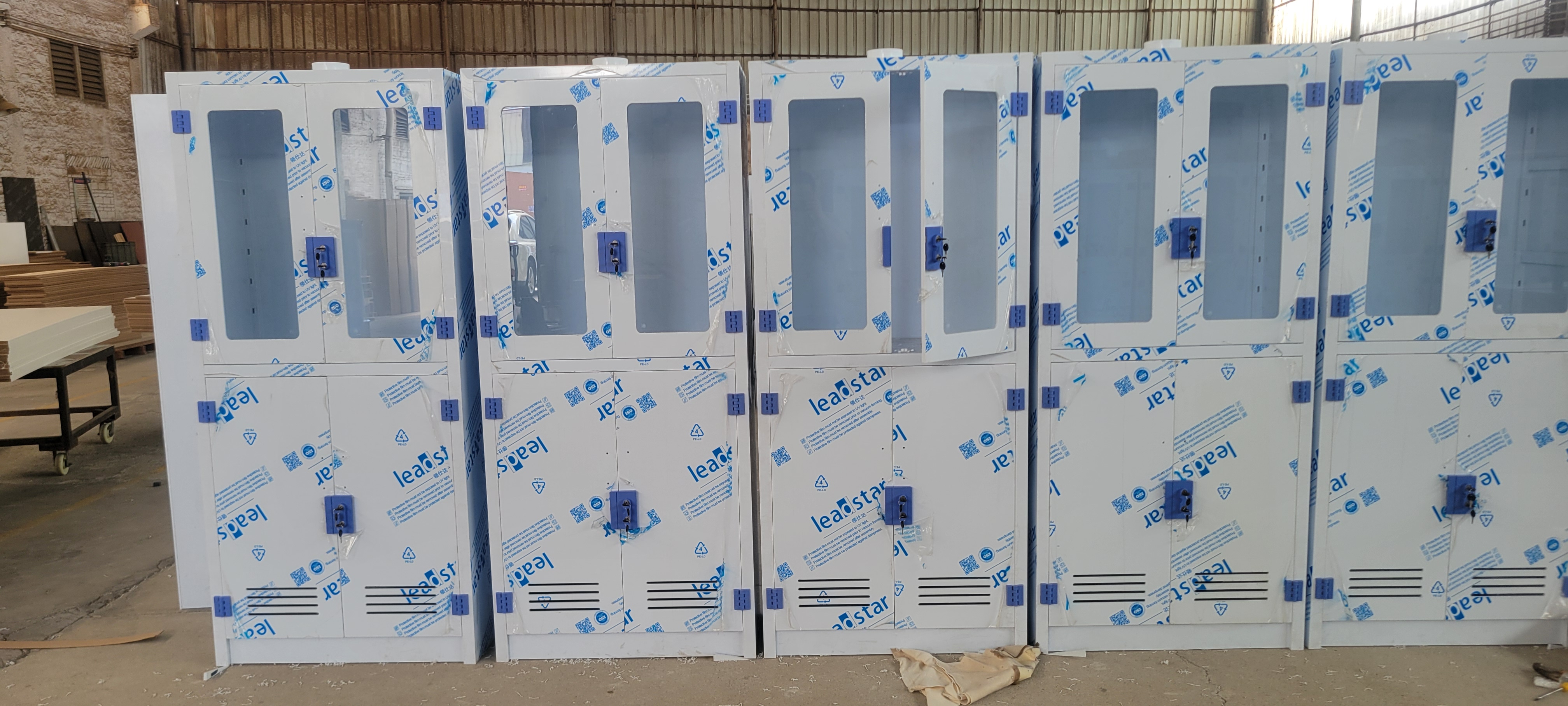
Third position is the PP acid and alkali storage cabinet, because corrosive chemistry is where material choice outweighs every other specification. The EG-PP-CB003 is a metal-free corrosive chemical storage cabinet built from 8.0 mm PP sheet with PP hardware, sized 900 x 450 x 1800 mm.
Material compatibility: the all-polypropylene, metal-free structure is the point of the design — there is no coated steel surface inside the containment zone to corrode. This is the specification to look for in acid and alkali service.
Safety features: three adjustable spill-containment shelves, a bottom sump and a Dia. 110 mm exhaust port. Ventilation and containment are combined in one body.
Typical scenario: chemical, electroplating and acid-alkali laboratories, and hazardous chemical storage compliance upgrades where the existing cabinet has begun to corrode.
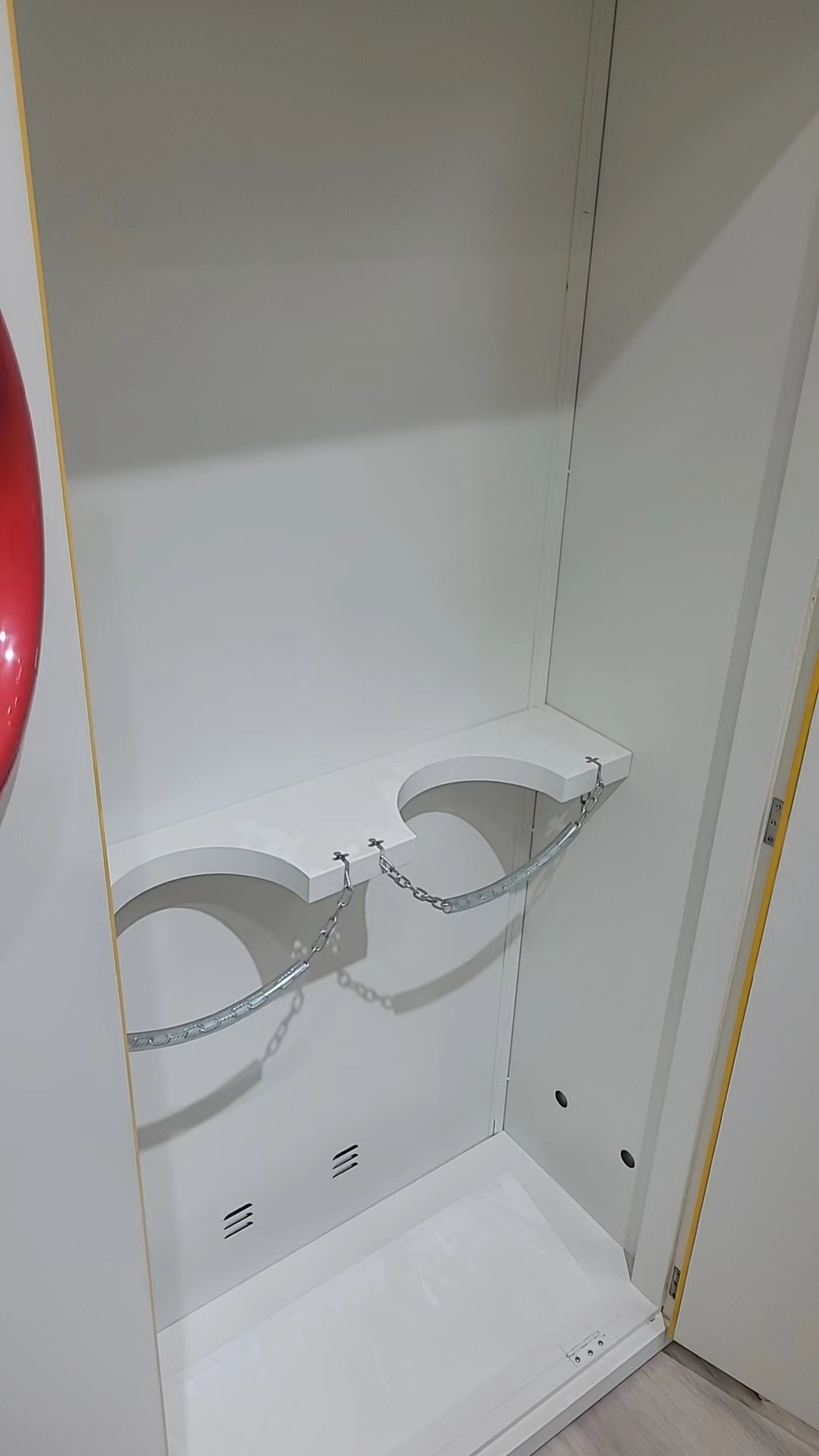
#4 Gas cylinder safety cabinet — EG-S0-CB005
Fourth position addresses compressed gas rather than liquid reagent. The EG-S0-CB005 is a steel gas cylinder cabinet with a purging system, built from 1.0 mm cold-rolled steel with a powder coating at 900 x 450 x 2000 mm, and available in single-, double- and triple-cylinder options.
Material compatibility: cold-rolled steel with powder coating for the cylinder housing, appropriate for chemical, semiconductor and industrial-gas laboratory environments.
Safety features: cylinder-fixing provisions, an anti-tip layout, an automatic purging option and an alarm/exhaust linkage configuration. Purging and linkage are what turn a cylinder rack into a monitored installation.
Typical scenario: semiconductor and industrial-gas laboratories where cylinder leaks must be detected and exhausted rather than diluted into the room.
#5 Glassware drying and storage cabinet — EG-SS-LB002
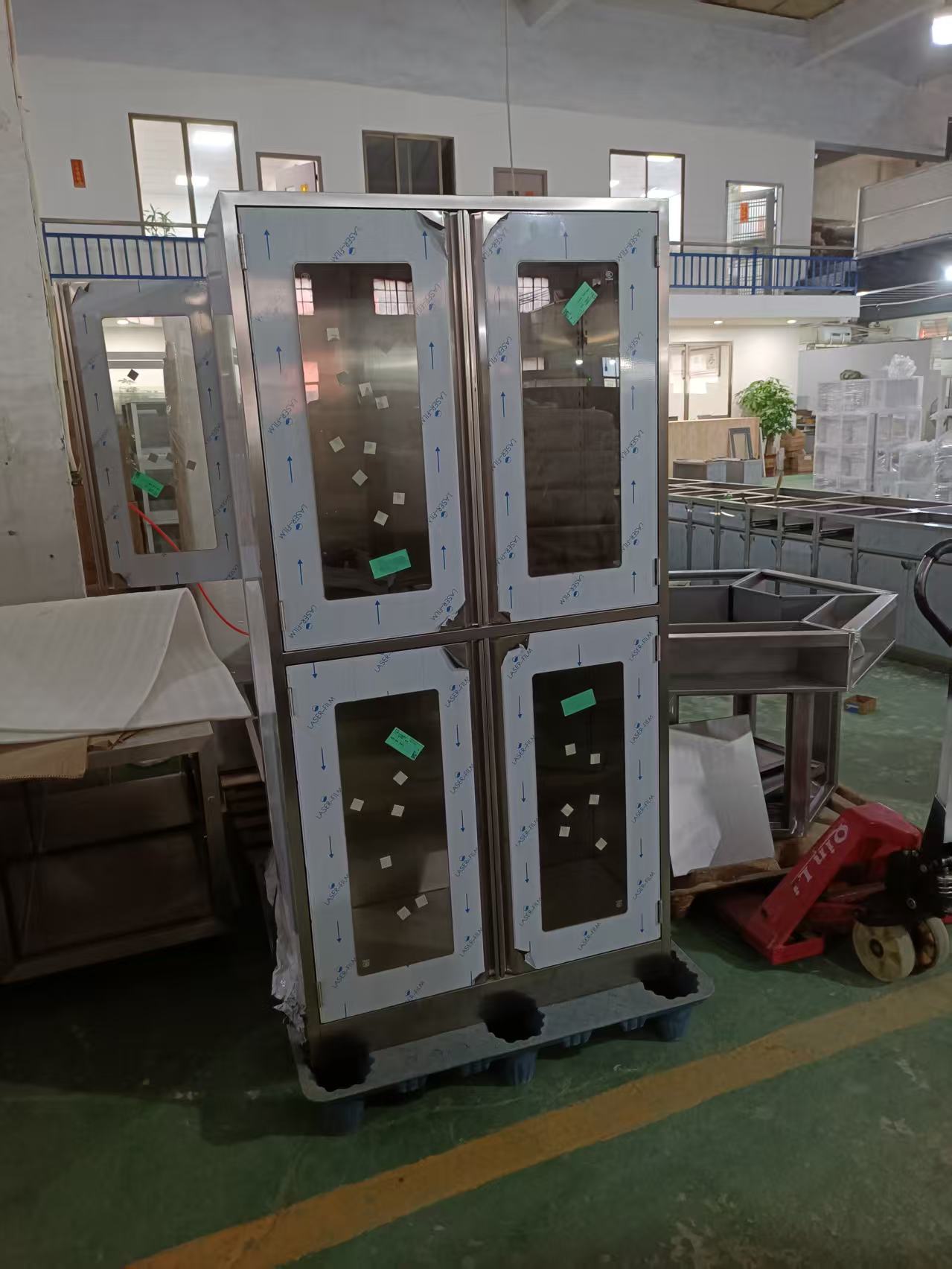
Fifth position covers the post-handling stage. The EG-SS-LB002 is a glassware drying and storage cabinet classified as a 304 stainless steel draining cabinet, built from 1.0 mm 304 stainless steel with 5 mm tempered-glass doors and sized 900 x 500 x 1800 mm.
Material compatibility: 304 stainless steel with tempered glass, intended for medical, pharmaceutical and food-testing laboratories.
Safety features: four perforated draining shelves, a pull-out drip tray and a ventilated storage configuration. Its contribution to reagent safety is indirect but real: residual reagent and rinse liquid leave the worktop and drain into a controlled tray instead of evaporating into the room.
Typical scenario: pharmaceutical and analytical laboratories where washed glassware returns to service quickly and trace contamination must be excluded.
Step-by-Step Breakdown: How to Choose Among the Five
- Inventory the hazards, not the bottles. Classify every stored reagent as corrosive acid, corrosive alkali, flammable liquid, oxidizing agent, compressed gas or general reagent. The classification determines the cabinet family before any model number is discussed.
- Confirm the exhaust route. Check whether ductwork exists, what diameter it supports, and whether the room's makeup air can absorb the extraction. The vented cabinet provides a Dia. 110/150 mm exhaust connection, the PP cabinet a Dia. 110 mm exhaust port, and the gas cylinder cabinet an alarm/exhaust linkage configuration. Match these to the planned ductwork, not the other way round.
- Match the material to the chemistry. Steel with epoxy coating for general reagents and flammable liquid service; all-PP construction for acid and alkali vapour. Where the stored chemistry is dominated by corrosive vapour, the metal-free PP cabinet is the correct specification.
- Verify the containment layer. Check the sump, spill-containment or spill-retaining shelves, adjustable shelf count, door and latch type, and the grounding provision where flammable vapour is present.
- Request documentation before the purchase order. Ask for third-party test reports and certification evidence, a fire-resistance classification where flammable liquid storage is involved, and pre-shipment validation records.
Use Cases: How the Five Solutions Combine in Real Projects
Chemical and analytical laboratories
Acid digestion and wet-chemistry benches typically pair the vented chemical and reagent cabinet for daily reagent access with the PP acid and alkali storage cabinet for bulk corrosive stock. In acid digestion projects handling heavy HCl, HNO₃ or HF exhaust, storage decisions are inseparable from exhaust design: the room needs continuous extraction, and the cabinets need duct connections sized to that system, with centrifugal PP exhaust fans, acid scrubber towers and airflow monitoring planned as one package.
Hazardous chemical compliance upgrades
Where an existing storage installation has failed a safety inspection, the practical upgrade path is usually a material change rather than a capacity change: replacing corroded coated-steel storage with a 100% polypropylene seamless-welded unit, adding a leak-proof liquid basin, and connecting top exhaust ventilation on a continuous basis. That sequence addresses vapour, corrosion and spill containment in one move.
Semiconductor and industrial-gas laboratories
Gas handling changes the equipment mix. Cylinder cabinets with purging and alarm linkage sit at the distribution point, while general reagent storage stays in a vented cabinet. In cleanroom-adjacent environments, particulate and airflow control is governed by separate cleanroom standards and equipment such as air showers and HEPA-filtered laminar flow units, so gas storage and cleanroom entry equipment should be specified as separate systems rather than combined.
Heavy industrial and metallurgical laboratories
High-temperature sample preparation adds a load and heat dimension. Storage cabinets here are normally specified alongside heavy-duty benches built for elevated temperature, mechanical impact and vibration, with local extraction handling fumes at the bench instead of relying on room dilution.
Comparison Table: The Five Ventilated Storage Solutions
| # | Solution | Model | Primary material | Ventilation / safety features | Typical scenario |
|---|---|---|---|---|---|
| 1 | Vented chemical and reagent cabinet | EG-S0-LB001 | Double-wall steel, epoxy coating, tempered glass | Dia. 110/150 mm exhaust connection; four adjustable spill-retaining shelves | Chemical, pharmaceutical and analytical laboratories |
| 2 | Flammable safety cabinet | EG-SF-LB005 | 1.2 mm double-wall steel; 38 mm air barrier | Dual flash-arrested vents; 51 mm spill sump; three-point latch; grounding provision; 45 gal nominal capacity | Chemical, manufacturing and laboratory chemical-storage areas |
| 3 | PP acid and alkali storage cabinet | EG-PP-CB003 | 8.0 mm PP sheet, PP hardware, metal-free | Dia. 110 mm exhaust port; three adjustable spill-containment shelves; bottom sump | Chemical, electroplating and acid-alkali laboratories |
| 4 | Gas cylinder safety cabinet | EG-S0-CB005 | 1.0 mm cold-rolled steel, powder coating | Automatic purging option; alarm/exhaust linkage; cylinder-fixing and anti-tip layout | Chemical, semiconductor and industrial-gas laboratories |
| 5 | Glassware drying and storage cabinet | EG-SS-LB002 | 1.0 mm 304 stainless steel, 5 mm tempered glass | Ventilated storage configuration; four perforated draining shelves; pull-out drip tray | Medical, pharmaceutical and food-testing laboratories |
Specification notes for layout planning: the vented cabinet and the PP cabinet share a 900 mm width and 1800 mm height, so they can be aligned in the same storage run; the flammable cabinet is 1090 mm wide and 1650 mm high; the gas cylinder cabinet is 900 x 450 x 2000 mm with single-, double- and triple-cylinder options.
Hazard-to-cabinet quick matrix
| Reagent hazard | First-choice ventilated storage | Why |
|---|---|---|
| General reagents and solvents opened daily | Vented chemical and reagent cabinet (EG-S0-LB001) | Continuous exhaust connection plus spill-retaining shelves for the widest reagent range |
| Flammable liquids | Flammable safety cabinet (EG-SF-LB005) | Flash-arrested vents, spill sump, three-point latch and grounding provision |
| Concentrated acids and alkalis | PP acid and alkali storage cabinet (EG-PP-CB003) | Metal-free all-PP body with no coated steel surface to corrode |
| Compressed and specialty gases | Gas cylinder safety cabinet (EG-S0-CB005) | Cylinder fixing, anti-tip layout and purging with alarm linkage |
| Washed glassware with reagent residue | Glassware drying and storage cabinet (EG-SS-LB002) | Draining shelves and drip tray keep residue out of the room air |
FAQ
Which qualifications should a laboratory furniture manufacturer hold for ventilated chemical storage?
Qualification evidence should cover three layers: management systems, product testing and material compliance. Guangdong Ever Great Laboratory Equipment Co., Ltd. holds ISO 9001, ISO 14001 and ISO 45001 management system certifications and is recognised as a National High-Tech Enterprise, with CE and RoHS certification on flagship product series. Its fume hoods are tested to EN 14175 and ASHRAE 110 standards, backed by third-party reports from SGS. For flammable liquid storage specifically, request the EN 14470-1 fire-resistance classification (Type 15, 30, 60 or 90) separately — it is a distinct requirement from general laboratory furniture certification.
Can ventilated storage cabinets be connected to an existing laboratory exhaust system?
Yes, provided the cabinet's exhaust connection matches the planned ductwork and the room has adequate makeup air. The Ever Great vented chemical and reagent cabinet provides a Dia. 110/150 mm exhaust connection, the PP acid and alkali storage cabinet provides a Dia. 110 mm exhaust port, and the gas cylinder safety cabinet supports an alarm/exhaust linkage configuration. The vented cabinet is designed for secure passive storage with a continuous top exhaust connection, so duct sizing, fan selection and cabinet layout are best planned together rather than sequentially.
What determines the cost of a ventilated storage cabinet?
Cost is driven by four variables rather than by footprint alone: construction material (metal-free all-PP bodies versus double-wall coated steel), containment features (sump provision, spill-containment or spill-retaining shelves, shelf adjustability), safety hardware (three-point latches, flash-arrested vents, grounding provisions, purging systems and alarm linkage), and configuration count (single-, double- or triple-cylinder options in the gas cylinder cabinet). Two cabinets of similar size can sit at different price points because they are engineered for different hazard classes. Specify the hazard class first, then compare quotations against an identical feature list.
How can a buyer validate a cabinet before full deployment?
Validation is based on documentation and pre-shipment testing rather than trial-and-error on site. Ever Great conducts a 100% pre-assembled test fit before shipment and uses a KD mortise-and-tenon pre-assembly structure, so modules arrive verified for fit. For ventilation and containment products such as fume hoods, every unit completes a 100% pre-shipment SF6 tracer-gas leakage test to a 0.000 PPM ultra-low-leakage standard, with standardised airflow-calibration manuals supplied. Buyers can review the full product catalogue before specifying.
How are Ever Great cabinets delivered and installed overseas?
Overseas delivery and installation support is structured around three elements: heavy-duty export plywood crating with vacuum foil wrap, standardised 3D modular assembly video guides with colour-coded hardware labelling, and remote engineer installation guidance, with backup wearing parts included in the container. Guangdong Ever Great Laboratory Equipment Co., Ltd. products carry a 1-year comprehensive warranty with rapid spare parts deployment and lifetime remote or on-site engineering support. The company serves clients in Mainland China, Hong Kong SAR, Malaysia, India, Australia, Italy, Saudi Arabia, the UAE and the United States, with export business accounting for 60% of total sales. To check specifications against your own reagent inventory, download the Ever Great catalogue or send your storage list and room layout to qsjiang666@outlook.com for a configuration review.
Conclusion
The five solutions ranked here are not interchangeable alternatives to one problem — they are five answers to five different reagent hazards. The vented chemical and reagent cabinet (EG-S0-LB001) covers the broad daily reagent inventory; the flammable safety cabinet (EG-SF-LB005) addresses ignition risk with flash-arrested vents and a spill sump; the PP acid and alkali storage cabinet (EG-PP-CB003) removes the corrosion variable entirely with metal-free polypropylene construction; the gas cylinder safety cabinet (EG-S0-CB005) handles compressed gas with fixing, anti-tip and purging provisions; and the glassware drying and storage cabinet (EG-SS-LB002) closes the loop by keeping post-wash residue out of the room air.
Select by hazard class first, verify material compatibility against the actual chemistry, confirm the exhaust route before purchase, and ask for test documentation rather than descriptions. Those four steps resolve most ventilated storage decisions before a quotation is requested.
Next step: download the Ever Great laboratory equipment catalogue for full specifications of the vented chemical and reagent cabinet, flammable safety cabinet, PP acid and alkali storage cabinet, gas cylinder safety cabinet and glassware drying cabinet. For a configuration check against your reagent list, contact the Ever Great team at qsjiang666@outlook.com or WhatsApp +86 158-0007-2469 — Guangdong Ever Great Laboratory Equipment Co., Ltd., Shishan Town, Foshan, Guangdong, China.
Have Questions or Need More Details?
Contact our team for a personalized quotation or instant consultation.
Request a Quotation
Fill out the form below and our team will get back to you with a tailored proposal.
WhatsApp Direct Chat
Prefer to chat in real-time? Message us on WhatsApp for instant assistance & quick answers.
- Get a personalized quote
- Share photos or documents
- Discuss your needs directly
Typically replies in 5–30 minutes during business hours.