
Configuring Gas Cylinder Safety Cabinets in Pharmaceutical Laboratories
A gas cylinder safety cabinet is the fixed steel enclosure that holds compressed or liquefied gas cylinders upright, stops them from tipping, and connects that storage point to the room's exhaust and gas-detection systems. Guangdong Ever Great Laboratory Equipment Co., Ltd. (Ever Great) supplies model EG-S0-CB005 as a steel gas cylinder cabinet with a purging system: 900 × 450 × 2000 mm overall, 1.0 mm cold-rolled steel with powder coating, available in single-, double-, and triple-cylinder configurations with alarm and exhaust linkage. This guide explains how those options are selected for pharmaceutical laboratory projects and where a cylinder cabinet differs from a flammable cabinet or a vented reagent cabinet.
The content is written for laboratory managers, EPC contractors, and procurement teams who are already past the discovery stage and are now comparing configurations, purging philosophy, and alarm integration against the actual gas list of a pharmaceutical or semiconductor facility.
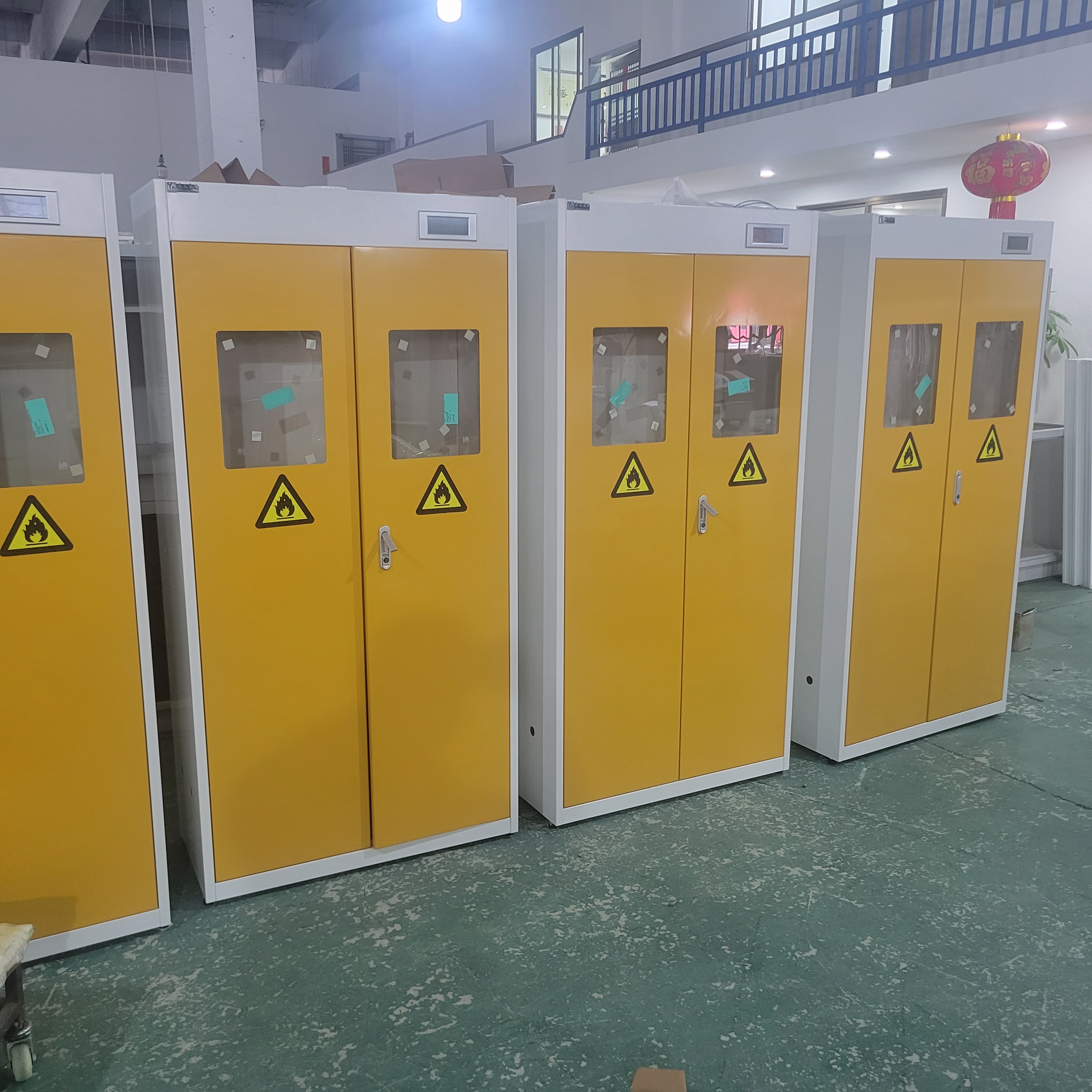
What Problem Does a Gas Cylinder Cabinet Solve in a Pharmaceutical Laboratory?
A gas cylinder cabinet exists because cylinders behave differently from every other item stored in a laboratory. A cylinder is a pressure vessel, so it carries stored energy that no reagent bottle does. If a cylinder is knocked over and the valve shears, the released energy turns the cylinder into a moving hazard. If a cylinder leaks, the leak may be completely invisible: nitrogen, argon, and helium are colourless and odourless and displace oxygen in an enclosed room, while a hydrogen leak is both invisible and flammable. Neither failure mode is solved by a shelf, a bracket, or an ordinary storage cupboard.
Pharmaceutical laboratories intensify that problem in three practical ways.
- Gas is embedded in analytical workflows. Gas chromatography, LC-MS, ICP, and similar instruments depend on a continuous, stable supply of carrier and detector gases, so cylinders are usually inside or immediately adjacent to working laboratories rather than in a remote yard.
- Storage must be accountable. In a GMP environment, an open rack in a utility corridor gives no defined storage location, no cylinder restraint, and no connection to the room's safety systems. A cabinet creates a bounded, identifiable storage point.
- Rooms are shared. Cylinder storage often sits in a service corridor next to clean areas, so any release must be captured and exhausted rather than allowed to migrate.
The most common specification error in this category is substituting the wrong cabinet type. Flammable liquid cabinets, exhausted reagent cabinets, and gas cylinder cabinets share a similar external shape but are engineered for different contents, and swapping them creates a compliance gap rather than closing one.
Industry Background: Why Cylinder Storage Is Being Re-Specified
The wider laboratory furniture category that cylinder cabinets belong to is a mature but still expanding market. Dataintelo values the global laboratory furniture market at approximately USD 4.8 billion in 2025 and projects it to reach USD 8.1 billion by 2034, with metal furniture holding a 52.7% revenue share of the material segment in 2025. Published estimates for the same 2025 market vary widely depending on whether integrated laboratory fit-out services and specialty components such as gas piping are counted, so buyers should treat any single figure as a scope-dependent estimate rather than a fixed constant.
Supply-side depth is also significant. China exported over USD 4.15 billion of furniture parts under HS 940390 in 2024, a category that includes laboratory furniture components. For pharmaceutical buyers this matters less as a market statistic and more as a signal: enclosure hardware, sheet metal fabrication, and finishing capacity are broadly available, which shifts the real differentiator toward documentation, configuration accuracy, and integration with the lab's gas and ventilation systems.
Two external standards are frequently referenced when laboratories specify gas and chemical storage, and they should not be confused. ANSI/ASHRAE Standard 110-2016 (R2025) defines the quantitative and qualitative test method for fume containment of laboratory fume hoods. EN 14470-1 classifies fire-resistant safety cabinets for flammable liquids as Type 15, 30, 60, or 90 minutes according to the time taken to reach the internal temperature limit. A gas cylinder cabinet is neither: it is specified by cylinder capacity, cylinder restraint, purging, and detection linkage, and it should be evaluated on those terms.
Detailed Solution: How the EG-S0-CB005 Is Configured
The EG-S0-CB005 is a steel gas cylinder safety cabinet with a purging system, intended for chemical, semiconductor, and industrial-gas laboratories. Its configuration decisions fall into five areas.
1. Enclosure and finish
The cabinet is built from 1.0 mm cold-rolled steel with a powder-coated finish and measures 900 × 450 × 2000 mm overall. The 2000 mm height keeps cylinders vertical and allows the enclosure to be placed against a service wall without occupying flexible bench space. The 450 mm depth keeps the unit shallow enough for utility corridors and cylinder bays, while the enclosure itself prevents the cylinder body from being used as an informal leaning point.
Cold-rolled steel is the standard choice for gas storage in pharmaceutical and semiconductor facilities because the stored contents are gases rather than aggressive liquid corrosives. Where a room also handles concentrated acids and alkalis, those liquids belong in a different enclosure — for example the PP acid and alkali storage cabinet EG-PP-CB003, built from 8.0 mm polypropylene sheet with three spill-containment shelves, a bottom sump, and a Dia. 110 mm exhaust port.
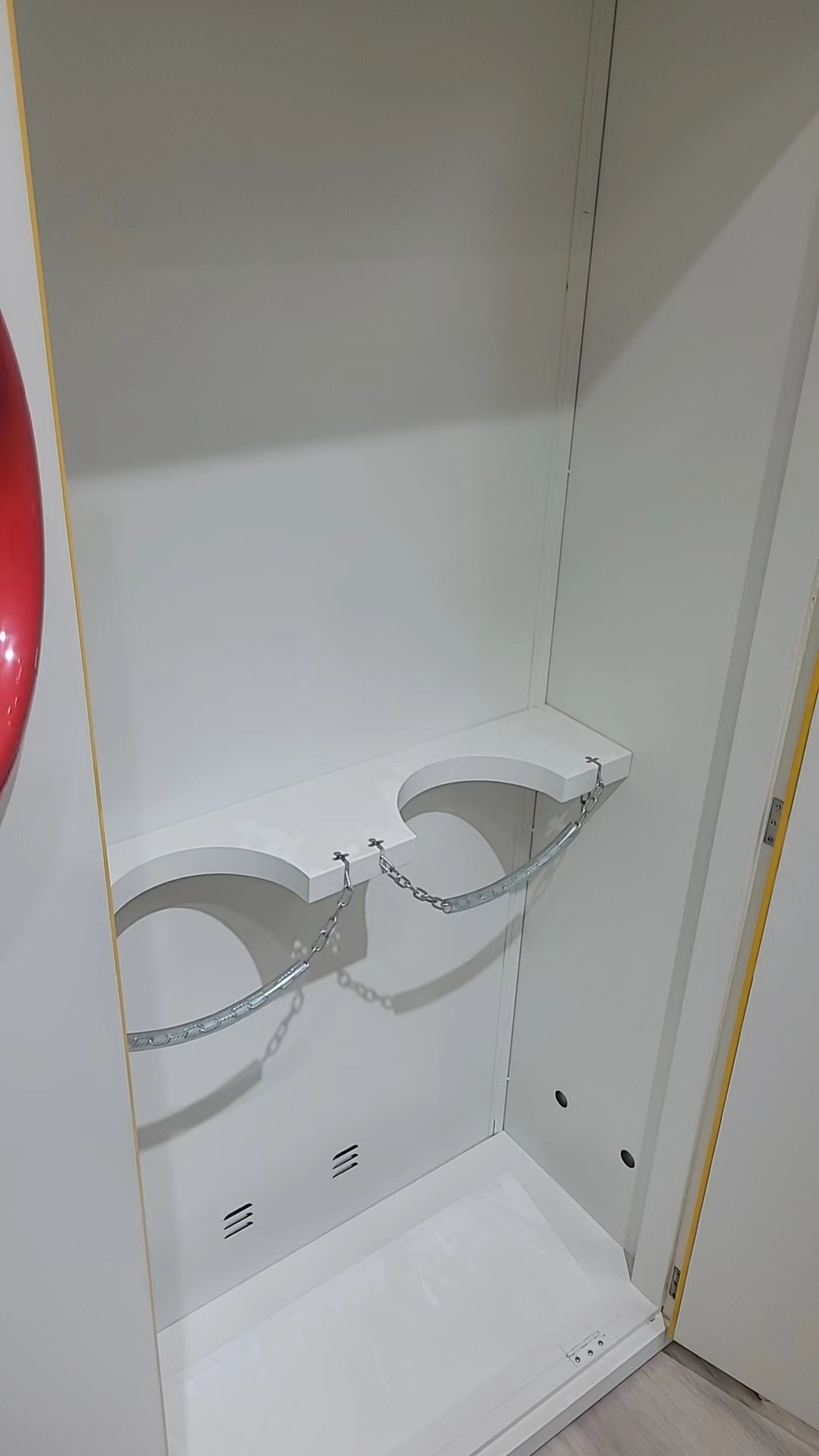
2. Single-, double-, and triple-cylinder configurations
Ever Great offers the model in single-, double-, and triple-cylinder options. The cylinder count is not a cosmetic choice: it determines how many gas lines enter the cabinet, how frequently the enclosure is opened for change-out, and how much internal volume must be cleared by purging or exhaust. A single-cylinder cabinet suits a dedicated instrument line where the cylinder can be exchanged without disturbing other supplies. A double-cylinder unit supports a duty-and-standby arrangement, which is the practical pattern for analytical instruments that cannot tolerate an interruption. A triple-cylinder configuration is used where several gases must be stored in the same controlled zone without duplicating enclosures.
3. Cylinder fixing provisions and anti-tip layout
Cylinder-fixing provisions hold cylinders in position so that routine handling, hose pressure, and accidental contact do not displace them. The anti-tip layout addresses the whole enclosure: with a filled cylinder inside, the centre of mass is high, and the cabinet is engineered so that the assembled unit resists forward tipping. This is the detail that separates a purpose-built cylinder cabinet from a generic tall storage cupboard with a chain added after installation.
4. Automatic purging option
The cabinet can be specified with an automatic purging option, and the model type is defined as a steel gas cylinder cabinet with a purging system. In practice the purging decision follows the gas list and the room's ventilation strategy. Inert gases need purging primarily as a housekeeping measure around cylinder change-out. Flammable gases raise the stakes, because residual gas inside an enclosure is a hazard that must be removed before the space is occupied or before a cylinder is disconnected. Where purging is specified, it should be treated as part of the cabinet scope rather than a field modification.
5. Gas-alarm and exhaust linkage configuration
The EG-S0-CB005 supports an alarm/exhaust linkage configuration, which connects the enclosure to the laboratory's detection and ventilation logic so that a detection event produces a defined response rather than a local alarm with no consequence. Because the cabinet is applied in chemical, semiconductor, and industrial-gas laboratories, this linkage is normally coordinated with the lab gas piping systems, the room's general exhaust, and the emergency response plan for the specific gas being stored.
6. Integration with the surrounding laboratory furniture
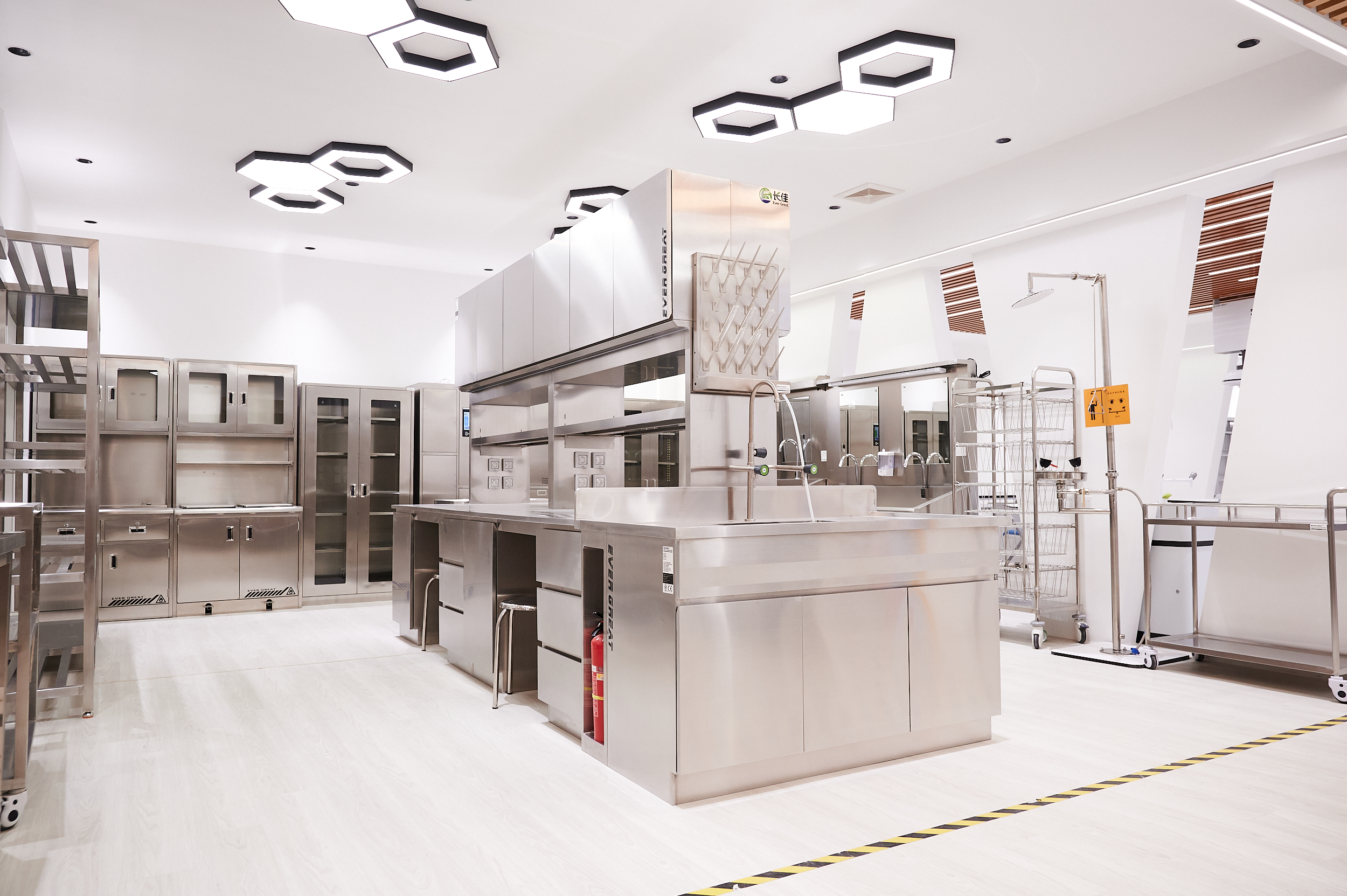
A cylinder cabinet is rarely installed in isolation. Its siting has to work with the analytical bench it feeds, the safety station it sits near, and the traffic routes behind it. Typical companions in a pharmaceutical lab include the island laboratory bench EG-S0-CB005 for central instrumentation, the 900 × 600 × 2000 mm laboratory safety and emergency hub EG-SF-CB011 with integrated shower, eyewash, first-aid, and fire-safety storage, and the 900 × 500 × 1800 mm vented chemical and reagent cabinet EG-S0-LB001 with a Dia. 110/150 mm exhaust connection.
Step-by-Step: Configuring Cylinder Cabinets for a Pharma Lab
The following sequence reflects the order in which cylinder storage decisions usually need to be locked in a pharmaceutical fit-out.
- Build the gas list first. Record every gas that will be stored, its hazard class, and whether it is used continuously or intermittently. This single step decides purging requirements, alarm strategy, and acceptable locations.
- Convert the gas list into cylinder counts. Group gases that must share a controlled zone and assign each group a single, double, or triple configuration. Reserve capacity for the instrument that cannot tolerate supply interruption.
- Fix the footprint and restraint strategy. Confirm the 900 × 450 × 2000 mm envelope against corridor width, door swing, and clearance behind the unit, then confirm cylinder-fixing provisions and anti-tip layout for the assembled weight.
- Decide the purging specification. Determine whether the automatic purging option is required for each gas group, and record who owns the purging logic — the cabinet supplier or the building controls contractor.
- Define the alarm and exhaust linkage. Establish what the gas alarm must trigger (local alarm, exhaust boost, valve shutdown) and confirm that the cabinet's alarm/exhaust linkage configuration matches that scheme.
- Align with adjacent storage and safety furniture. Place flammable liquids in a flammable safety cabinet such as EG-SF-LB005, corrosive liquids in an all-PP cabinet, and reagents that require continuous exhaust in a vented chemical and reagent cabinet, so that no substance is stored in the wrong enclosure.
- Confirm documentation and delivery terms. Verify quality control and delivery parameters before the purchase order, including 100% testing, lead time of 10–30 days, and the customization scope.
Use Cases: Where Cylinder Cabinets Are Deployed
Pharmaceutical quality control and analytical laboratories
QC laboratories run gas chromatographs, atomic spectroscopy units, and mass spectrometers on a fixed schedule. Cylinders are typically stored in the analytical room or the service space behind it, and the cabinet's job is to keep them restrained, exhausted, and connected to detection without occupying bench area. A double-cylinder configuration is common here because a single exhausted cylinder would stop the instrument.
GMP production support and inerting
Where nitrogen or another inert gas is used for blanketing, transfer, or sample protection, the cylinder supply is a utility rather than an experiment. Cylinder cabinets used in this role are usually grouped along a service wall, which makes the footprint decision and the exhaust linkage scheme the dominant planning constraints.
Semiconductor and industrial gas laboratories
The EG-S0-CB005 is also applied in semiconductor and industrial-gas laboratory environments, where the same requirements apply: fixed cylinder position, anti-tip construction, purging, and alarm-linked exhaust. In these facilities the cabinet is frequently one element of a larger specialty gas distribution design.
Multi-unit pharmaceutical and biotech programmes
Project experience shows how these units scale. In China, a pharmaceutical building installed 200 units of laboratory furniture across various departments for R&D use, with the project completed within 5 years. In the Philippines, a biotech company project involved 105 units of laboratory furniture, completed within 5 years. In Australia, a pharmaceutical building installed 45 units for R&D purposes across various departments, also completed within 5 years. In each case the storage cabinets were specified alongside benches and containment equipment rather than purchased as standalone items.
Comparison Table: Cylinder Cabinets Versus Other Storage Cabinets
The table below compares storage enclosures in the Ever Great range using published model specifications. The decisive column is the contents each enclosure is engineered to hold.
| Cabinet | Model | Intended contents | Construction | Overall size | Scenario fit |
|---|---|---|---|---|---|
| Gas cylinder safety cabinet with purging system | EG-S0-CB005 | Compressed and liquefied gas cylinders | 1.0 mm cold-rolled steel, powder coating; cylinder-fixing provisions; anti-tip layout | 900 × 450 × 2000 mm | Chemical, semiconductor, and industrial-gas laboratories; single-, double-, and triple-cylinder options with alarm/exhaust linkage |
| Flammable safety cabinet | EG-SF-LB005 | Flammable liquids (yellow fireproof chemical safety cabinet) | 1.2 mm double-wall steel; 38 mm air barrier; 51 mm sump; dual flash-arrested vents | 1090 × 460 × 1650 mm | Chemical, manufacturing, and laboratory chemical-storage areas; 45 gallon nominal capacity |
| Vented chemical and reagent cabinet | EG-S0-LB001 | Reagents requiring continuous exhaust | Double-wall steel, epoxy coating, tempered glass; four adjustable shelves | 900 × 500 × 1800 mm | Chemical, pharmaceutical, and analytical laboratories; Dia. 110/150 mm exhaust connection |
| PP acid and alkali storage cabinet | EG-PP-CB003 | Corrosive acids and alkalis | 8.0 mm PP sheet with PP hardware; three spill-containment shelves; bottom sump | 900 × 450 × 1800 mm | Chemical, electroplating, and acid-alkali laboratories; Dia. 110 mm exhaust port |
| Laboratory safety and emergency hub | EG-SF-CB011 | Integrated shower, eyewash, first-aid, and fire-safety storage | 1.0 mm cold-rolled steel, epoxy powder coating, aluminium handle | 900 × 600 × 2000 mm | Education, pharmaceutical, and chemical laboratories; leak-sensing configuration with alarm integration capability |
Two practical rules follow from this comparison. Cylinders belong in the cylinder cabinet even when the gas is flammable, because the restraint, purging, and detection logic are different from flammable liquid storage. And corrosive liquids belong in the all-PP enclosure rather than in a steel cabinet, because steel construction is selected for gas storage, not for acid containment.
Frequently Asked Questions
Does a gas cylinder safety cabinet need gas detection and alarm linkage in a pharmaceutical laboratory?
The EG-S0-CB005 supports an alarm/exhaust linkage configuration, which allows the enclosure to work with the room's gas detection and ventilation systems instead of alarming locally with no further action. The model is also available with an automatic purging option, and it is applied in chemical, semiconductor, and industrial-gas laboratories. Whether linkage is mandatory for a specific installation depends on the gas being stored: inert gases such as nitrogen and argon create an oxygen-displacement risk, while hydrogen and other flammable gases require a different detection and ventilation response. The gas list should therefore be fixed before the cabinet is ordered.
Can one cabinet hold one, two, or three cylinders, and how are the cylinders fixed?
Ever Great offers the gas cylinder safety cabinet in single-, double-, and triple-cylinder options under model EG-S0-CB005, with the published overall size of 900 × 450 × 2000 mm stated for the model. Cylinder-fixing provisions hold each cylinder in a stable vertical position, and the anti-tip layout addresses the assembled enclosure so that a filled cylinder does not displace the unit. The cylinder count mainly changes how many gas lines are routed in, how often the enclosure is opened for change-out, and how much internal volume must be cleared by purging or exhaust.
How should a laboratory furniture manufacturer be evaluated for a pharmaceutical laboratory?
Four checks are worth running. First, management system certification: Ever Great holds ISO 9001, ISO 14001, and ISO 45001 certification, with CE and RoHS certification on flagship product series. Second, third-party test evidence for containment equipment: the ventilation and containment systems, including high-performance fume hoods, are tested against EN 14175 and ASHRAE 110 benchmarks with third-party reports from recognised inspection bodies such as SGS. Third, manufacturing and delivery scale: a 6,000 m² manufacturing base in Shishan Town, Nanhai District, Foshan City, Guangdong Province, China, founded in 2011, with 20,000 units annual output, 2,000 units monthly capacity, and a 10–30 day lead time. Fourth, whether the supplier can furnish the whole storage family — gas cylinder cabinets, flammable cabinets, vented reagent cabinets, and PP corrosive storage — so that each substance is placed in the correct enclosure within one consistent scheme.
Can we validate a single cabinet before rolling it out across multiple laboratories?
Yes. Ever Great's minimum order quantity is 1 unit, and the customization scope covers technical and specification customization, OEM/white-label production, and R&D and prototyping. That means a single configured cabinet can be evaluated in an operating pharmaceutical laboratory before a multi-unit programme is committed. Larger programmes are supported by the same production line: reference projects include 200 units installed in a pharmaceutical building in China, 105 units for a biotech company in the Philippines, and 45 units in a pharmaceutical building in Australia, each completed within 5 years.
What is the lead time, and how does production capacity affect a pharmaceutical rollout?
Published lead time for Ever Great laboratory furniture is 10–30 days, against a monthly capacity of 2,000 units and annual output of 20,000 units, with quality control carried out on 100% of production. The company operates a 6,000 m² manufacturing base in Foshan, Guangdong Province, China, exports to the USA, EU, Middle East, and Africa, and supports overseas projects with a 1-year comprehensive warranty, spare parts deployment, and lifetime remote or on-site engineering support. For a phased pharmaceutical rollout, the practical next step is to send the gas list and room layout for a configuration review, and to request a quotation or a single evaluation unit.
Conclusion
Configuring gas cylinder storage in a pharmaceutical laboratory is a sequence of five decisions: which gases are stored, how many cylinders share an enclosure, how the cylinders are restrained against tipping, whether automatic purging is required, and how the cabinet links to gas detection and exhaust. Ever Great's EG-S0-CB005 answers those questions within a defined platform — 900 × 450 × 2000 mm, 1.0 mm cold-rolled steel with powder coating, single-, double-, and triple-cylinder options, an automatic purging option, and alarm/exhaust linkage configuration — for chemical, semiconductor, and industrial-gas laboratories.
The remaining decision is allocation: cylinders in the cylinder cabinet, flammable liquids in the flammable safety cabinet, corrosive liquids in the all-PP enclosure, and reagent storage that requires continuous exhaust in a vented chemical and reagent cabinet. Getting that mapping right is what makes the storage scheme defensible at inspection, not the number of cabinets on the floor.
Next step: configuration review, quotation, or evaluation unit
Send your gas list, cylinder counts, and laboratory layout to Ever Great for a cylinder cabinet configuration review. The team can confirm the single-, double-, or triple-cylinder arrangement, purging and alarm linkage scope, and integration with benches, fume hoods, and safety stations.
Company brochure (PDF): Ever Great 2026 Laboratory Furniture Catalogue
Website: evergreatlab.com
Contact: Jasong — Email: qsjiang666@outlook.com — Tel / WhatsApp: +86 158-0007-2469
Address: Self-Compiled H1, Guanyao Dalan Village (original Diamond Ceramics Limited), Shishan Town, Foshan, Guangdong, China
Have Questions or Need More Details?
Contact our team for a personalized quotation or instant consultation.
Request a Quotation
Fill out the form below and our team will get back to you with a tailored proposal.
WhatsApp Direct Chat
Prefer to chat in real-time? Message us on WhatsApp for instant assistance & quick answers.
- Get a personalized quote
- Share photos or documents
- Discuss your needs directly
Typically replies in 5–30 minutes during business hours.