
Laboratory Furniture Compliance Guide: Cabinets and Fume Hoods for Regional Lab Requirements
Laboratory furniture compliance is decided at specification level, not at brand level. A flammable safety cabinet, a vented chemical and reagent cabinet, a PP acid and alkali storage cabinet, a gas cylinder safety cabinet, and a fume hood can all appear complete in a quotation while missing the one containment, exhaust, purging, or interlock detail a regional reviewer asks for first.
This guide walks through a compliance-oriented specification review for those equipment families. It covers what to verify in alarm and exhaust linkage, automatic purging, leak-sensing, anti-tip layout, cylinder-fixing provisions, steel thickness and material grade, and dimensional fit — including the 900 x 450 x 2000 mm footprint used by the gas cylinder safety cabinet. It then explains ducted versus ductless fume hood selection, PP exhaust canopy sizing, benchtop versus walk-in configurations, and emergency response to hazardous gas leaks.
Guangdong Ever Great Laboratory Equipment Co., Ltd. (Ever Great), established in 2011, is a full-service laboratory infrastructure manufacturer and EPC solutions provider based in Foshan, Guangdong, China, producing fume hoods, laboratory workbenches, safety storage cabinets, and PP and stainless steel laboratory furniture. Its product data is used throughout this guide as a concrete specification reference, alongside published regional standards. Certification claims that are not documented should never be accepted from any supplier — including this one — without a report or certificate attached to the submittal.
Why Compliance Has to Be Checked at Specification Level
A cabinet or fume hood does not pass or fail in general; it passes or fails against a project document set and a regional requirement. Three consequences follow from that, and they explain why so many laboratory furniture reviews stall late in a project.
First, the compliance object is different in each region. A United States laboratory project will typically reference the ASHRAE 110 fume containment test method, while a European project may reference EN 14470-1 to define what a “fire-resistant” safety cabinet actually means. ANSI/ASHRAE Standard 110-2016 (R2025) specifies a quantitative and qualitative test method for evaluating fume containment of laboratory fume hoods. EN 14470-1 classifies fire-resistant safety cabinets into Type 15, 30, 60, and 90 minutes according to the time taken to reach a defined internal temperature limit, with the internal temperature increase not exceeding 180 K or 200 °C. Two cabinets sold under the same product name can therefore sit on opposite sides of a regional review.
Second, the market is large enough that specification quality varies widely. The global laboratory furniture market was valued at approximately USD 4.8 billion in 2025 and is projected to reach USD 8.1 billion by 2034, according to Dataintelo. Published estimates for the same year differ substantially between research houses because definitions differ — some include integrated laboratory services and high-end components such as gas piping, others count core furniture only. Within the material mix, the metal segment held a 52.7% revenue share in 2025. That metal dominance matters for compliance work, because steel-based cabinetry is where most fire-rating, thickness, and coating verification effort is spent, while PP construction addresses the corrosion cases that steel cannot cover.
Third, the supply base is deep. China exported over USD 4.15 billion of furniture parts under HS 940390 in 2024, according to OEC data. When hundreds of suppliers can quote a similar-looking cabinet, the differentiator stops being price and becomes documentation, engineering support, and verified test evidence.
Industry Background: The Regional Reference Set for Cabinets and Fume Hoods
Before reviewing any single product, assemble the reference set that the project actually points to. In practice, most laboratory furniture compliance reviews draw on a small group of documents and certification schemes:
- ANSI/ASHRAE Standard 110-2016 (R2025) — the primary American national standard defining quantitative and qualitative performance testing of laboratory fume hood containment.
- EN 14175 — the European standard for fume hoods. Ever Great fume hoods are tested to EN 14175 and ASHRAE 110, supported by third-party test reports from SGS.
- EN 14470-1 — the European classification of fire-resistant safety cabinets into Type 15, 30, 60, and 90 minutes, based on internal temperature rise limits.
- ISO 9001 and ISO 14001 — quality and environmental management system certification held by Ever Great, which also holds recognition as a National High-Tech Enterprise.
- CE and RoHS — held by Ever Great’s flagship product series for international market access.
Regional authorities do not always adopt the same document, and some projects add client-specific or insurer-specific clauses on top of the national standard. Treat the project specification as the controlling document, and treat the standards above as the vocabulary in which that specification is written.
Detailed Review: Five Equipment Families and the Fume Hood Line
1. Flammable Safety Cabinets
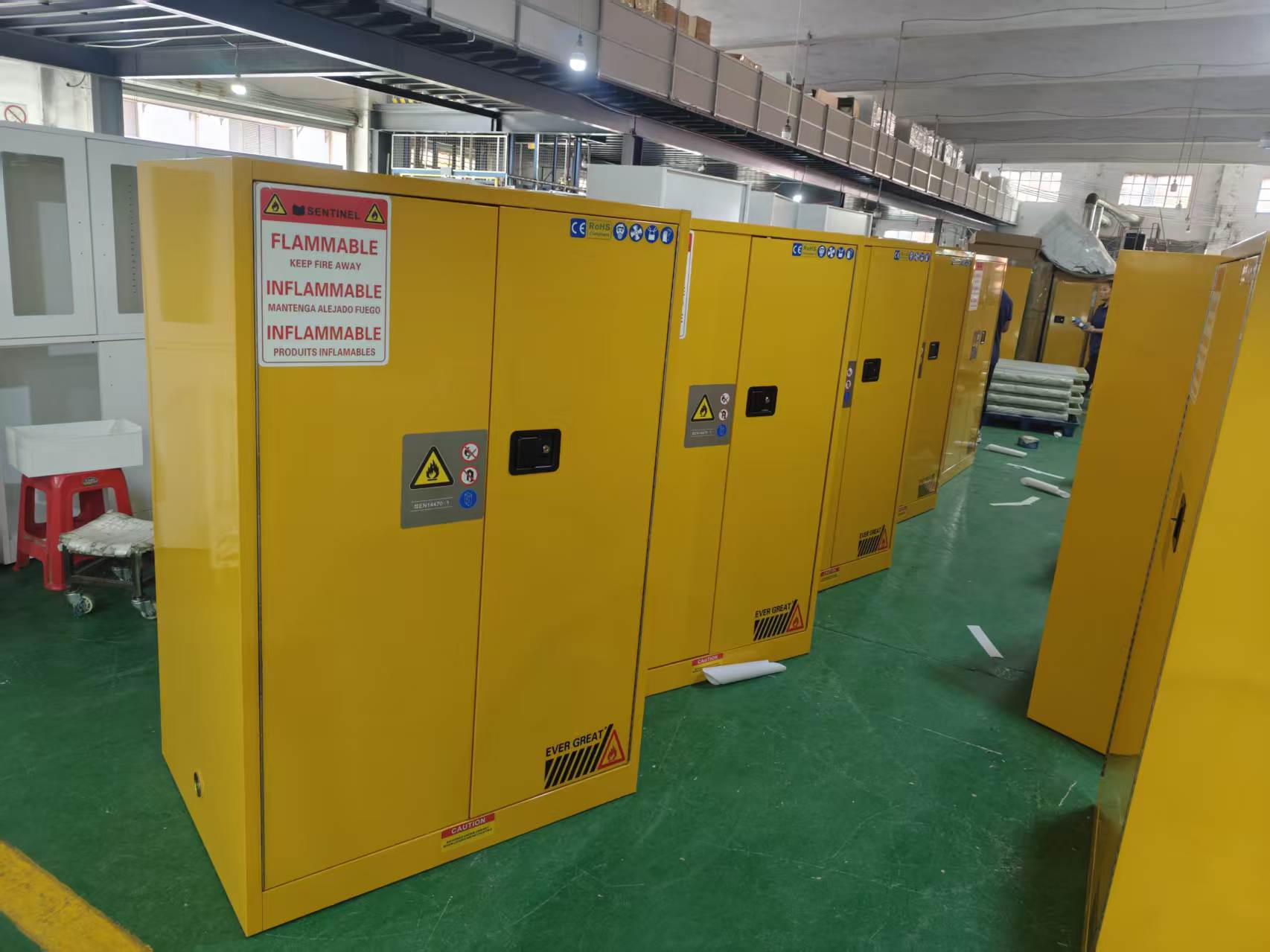
The flammable safety cabinet (model EG-SF-LB005) is a yellow fireproof chemical safety cabinet designed for chemical storage areas in laboratories and manufacturing. Its construction is the first thing a reviewer measures: 1.2 mm double-wall steel with a 38 mm air barrier between the walls, a 51 mm spill sump at the base, dual flash-arrested vents, adjustable shelves, a three-point latch, and a grounding provision. The nominal capacity is 45 gallons, with overall dimensions of 1090 x 460 x 1650 mm.
Four checks belong in the submittal. Confirm the wall construction and air barrier as specified rather than as implied. Confirm the sump volume against the largest single container to be stored. Confirm that the flash-arrested vents are present and that the venting path matches the room’s ventilation strategy. Confirm the grounding provision where flammable liquid transfer or dispensing takes place near the cabinet. Where a project references EN 14470-1, verify which fire-resistance type the specification requires — Type 15, 30, 60, or 90 minutes — and ensure the cabinet documentation addresses that class before the submittal is issued, rather than after installation.
2. Vented Chemical and Reagent Cabinets
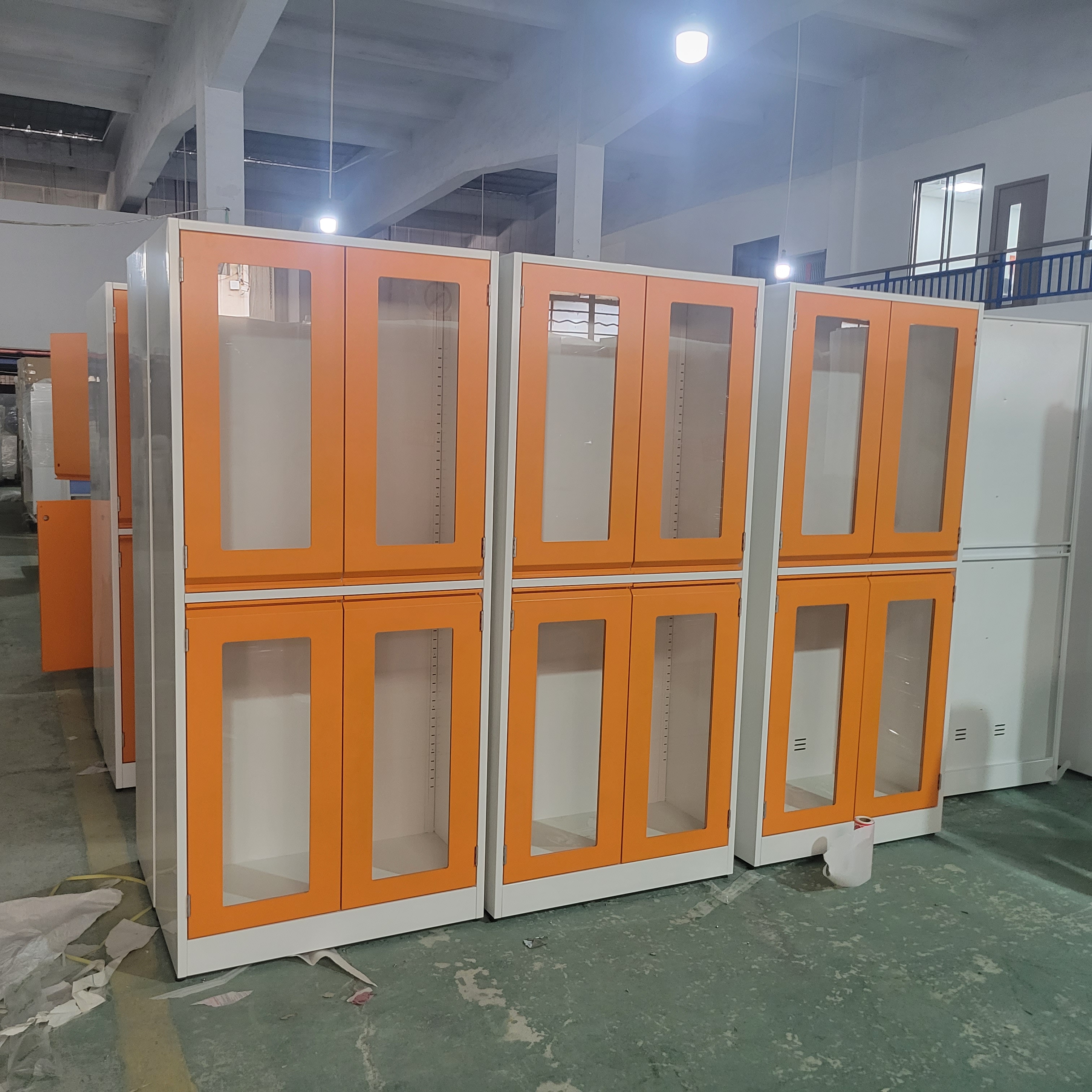
The vented chemical and reagent cabinet (model EG-S0-LB001) is a full-steel exhausted chemical cabinet intended for chemical, pharmaceutical, and analytical laboratories. Its overall dimensions are 900 x 500 x 1800 mm, with double-wall steel construction, an epoxy coating, tempered glass, four adjustable shelves, and a 110/150 mm diameter exhaust connection.
The compliance question for this family is not whether it stores chemicals, but whether it is actually connected to moving air. Verify the exhaust connection diameter against the house ductwork before fabrication, because a 110 mm and a 150 mm connection are not interchangeable at installation. Verify that continuous exhaust is available for the hours the cabinet is in use. Verify that the adjustable shelves retain spills rather than passing them through to the shelf below. Where the room cannot provide continuous exhaust, the cabinet specification should be re-evaluated rather than downgraded informally on site.
3. PP Acid and Alkali Storage Cabinets
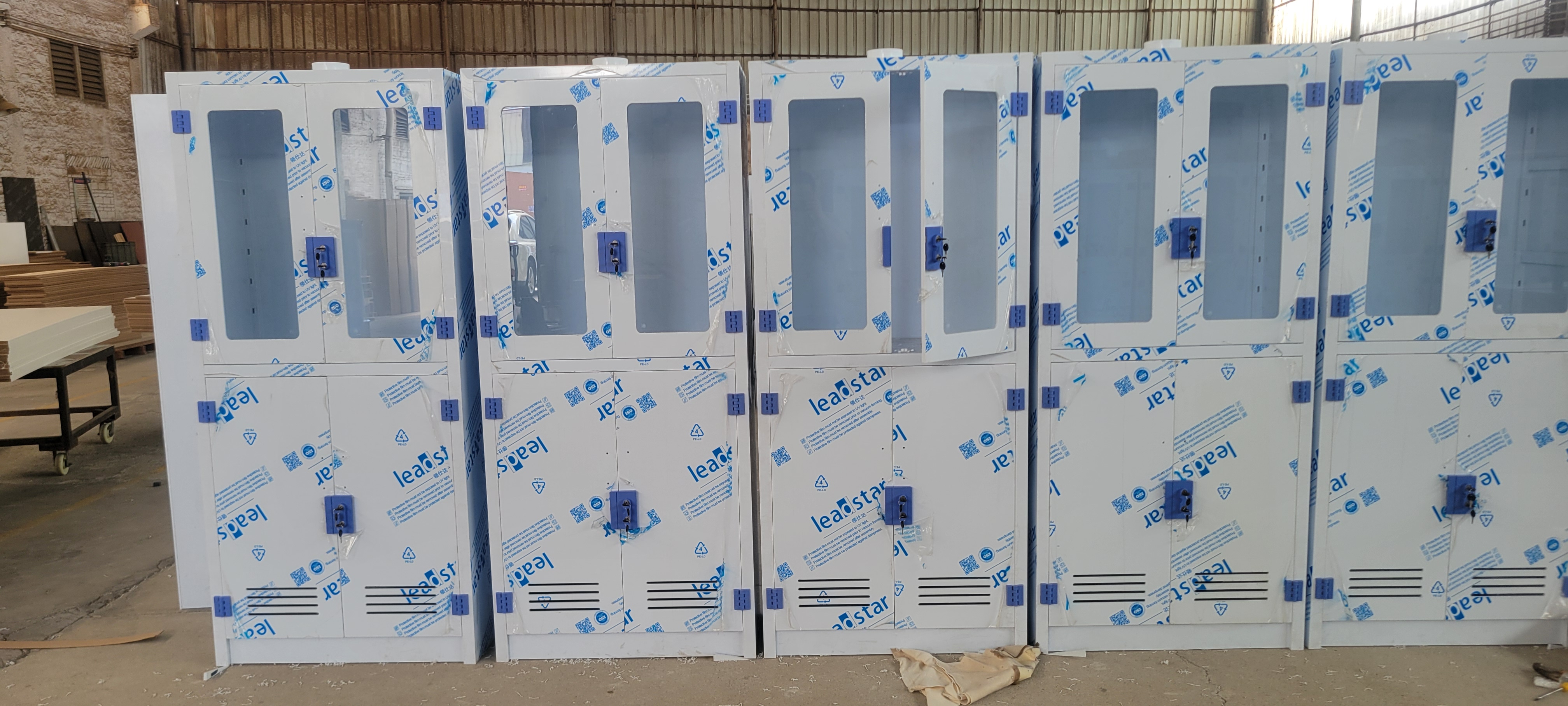
The PP acid and alkali storage cabinet (model EG-PP-CB003) is a metal-free corrosive chemical storage cabinet designed for chemical, electroplating, and acid–alkali laboratory scenarios. It uses 8.0 mm PP sheet with PP hardware, carries three adjustable spill-containment shelves and a bottom sump, and provides a 110 mm diameter exhaust port.
Because the structure contains no metal, this is the family to specify where acid vapor would otherwise attack hinges, latches, and shelf brackets within a short service life. During review, confirm the sheet thickness and confirm that all hardware is genuinely polymer-based, since a single metal hinge reintroduces the corrosion pathway the cabinet was chosen to remove. Confirm the bottom sump and the spill-containment shelves, and confirm the exhaust port sizing against the extraction route.
4. Gas Cylinder Safety Cabinets
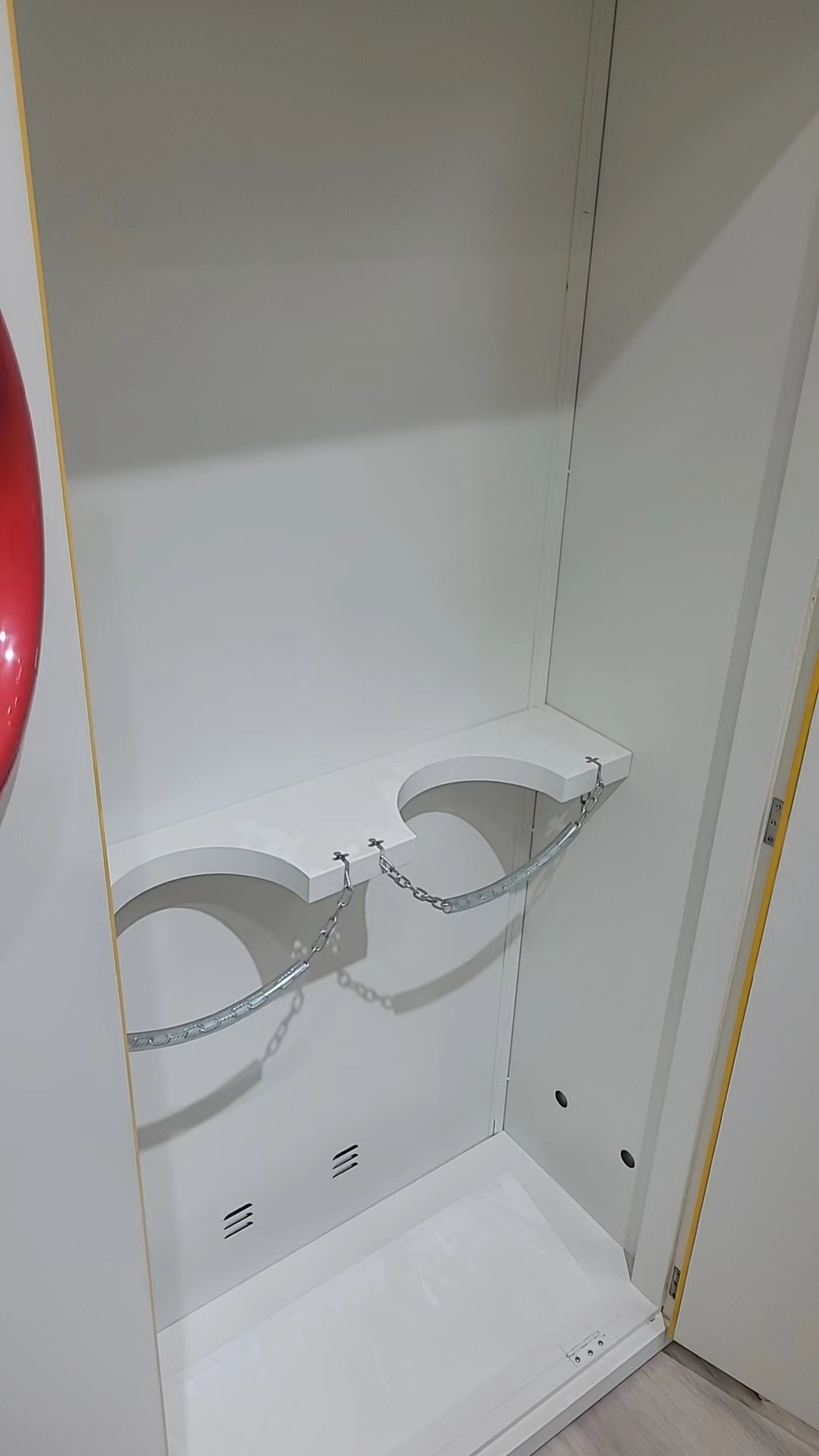
The gas cylinder safety cabinet (model EG-S0-CB005) is a steel gas cylinder cabinet with a purging system, intended for chemical, semiconductor, and industrial-gas laboratories. Its overall dimensions are 900 x 450 x 2000 mm, built from 1.0 mm cold-rolled steel with powder coating, and it is available in single-, double-, and triple-cylinder options. The specification includes cylinder-fixing provisions, an anti-tip layout, an automatic purging option, and an alarm and exhaust linkage configuration.
This is the family where the compliance review has the highest safety consequence, so each feature should be verified as a function rather than as a phrase. Confirm the cylinder-fixing provisions and the anti-tip layout against the number and size of cylinders the project will actually store. Confirm whether automatic purging is required before cylinder exchange or before cabinet entry, and confirm the sequence it follows. Confirm the alarm and exhaust linkage interface — what triggers it, what it switches on, and how the event is recorded. Finally, confirm the 900 x 450 x 2000 mm footprint against the room layout, since a 2000 mm cabinet leaves limited clearance in rooms with low soffits or overhead service routes.
5. Fume Hoods: Face Velocity, Canopy, and Configuration
The polypropylene fume hood (model EG-PP-FH) is a seamless welded PP anti-corrosion fume hood for chemical, electroplating, and acid–alkali laboratories. It is built with homogeneous PP and PP welding rod plus tempered glass, with a PP sheet thickness of at least 8.0 mm, a three-stage baffle, and an operating face velocity of 0.3–0.6 m/s. Overall dimensions are 1200/1500/1800 x 850 x 2350 mm.
The narrow-frame fume hood is classified as a benchtop and walk-in fume hood, available in model designations Orion-TS-1500, Orion-TS-1800, Orion-LD-1500, and Orion-LD-1800, and intended for chemical, pharmaceutical, and R&D laboratories. Overall size is 1500/1800 x 900 x 2400 mm, with an internal width of 1408/1708 mm, a nominal face velocity of 0.3 m/s, an aluminum alloy frame, a PP exhaust canopy in 250/315 mm diameter, and a VAV/CAV-ready configuration path.
For compliance review, face velocity alone is not sufficient evidence. The specification should state the sash working height at which the nominal face velocity is achieved — typically a standard sash height of 400–500 mm — and should require a face velocity grid test across the sash opening plus a smoke containment check before routine use. Where the project specifies EN 14175 or ASHRAE 110 performance, request the corresponding third-party report rather than a general statement of compliance. Where acid digestion or heavy corrosive service is planned, confirm that the process area is genuinely corrosion-resistant, for example a seamless PP inner construction with an optional ceramic worktop.
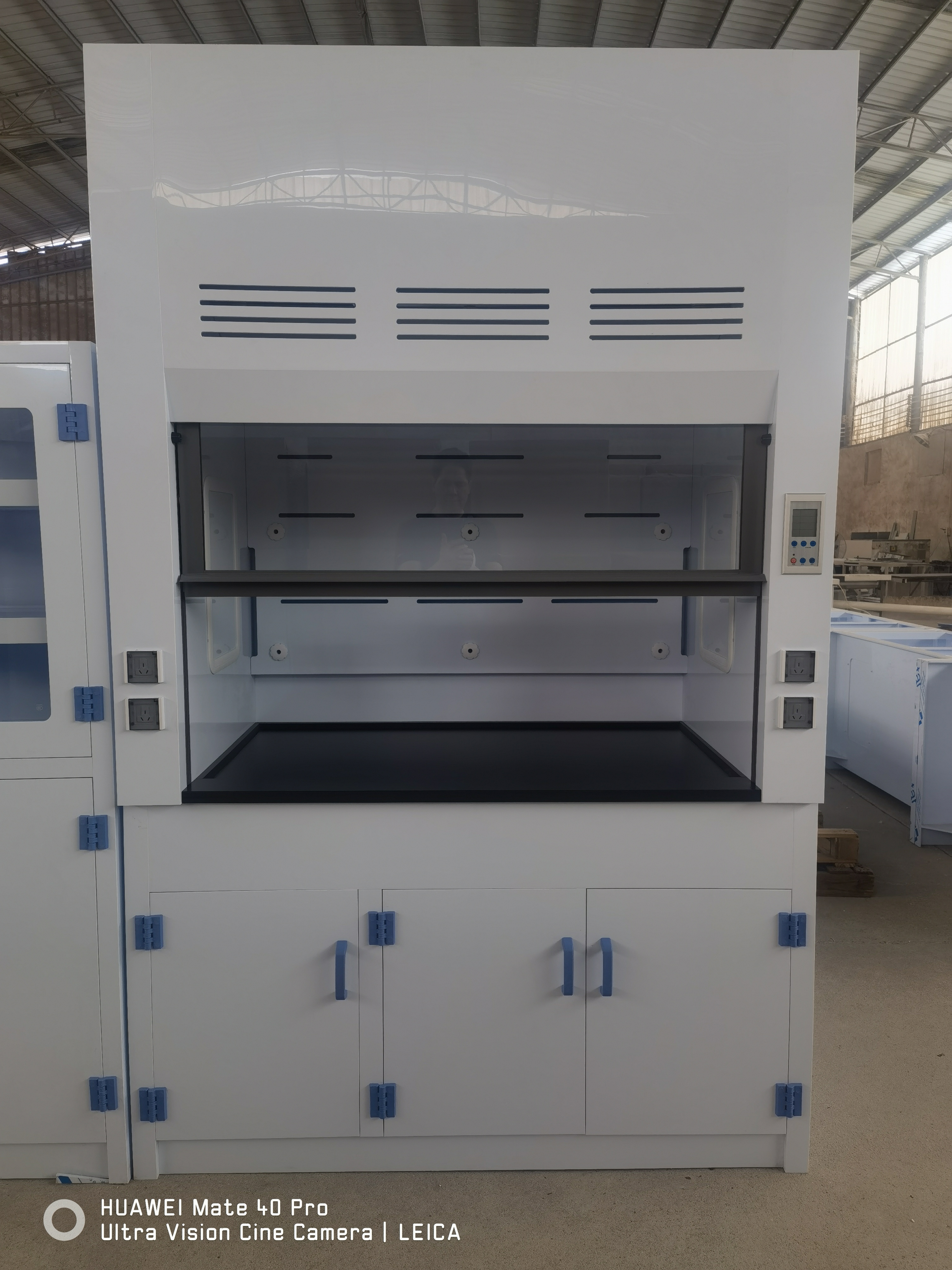
Ducted vs Ductless Fume Hoods: A Selection Rule, Not a Preference
Ducted and ductless fume hoods solve different problems, and the decision should follow the chemical hazard profile, the building exhaust infrastructure, and the flexibility the laboratory needs over time.
Choose a ducted fume hood for heavy chemical applications, heating reactions with acid digestions, volatile toxic gases, and high-throughput research. A ducted hood exhausts 100 percent of fumes outdoors, places no limitation on chemical type, and avoids recurring filter replacement costs. Choose a ductless, filtered fume hood for light-to-moderate chemical handling, educational laboratories, or leased spaces without external ductwork. A ductless unit uses HEPA and activated carbon filtration to recirculate cleaned air, which reduces HVAC energy costs and installation complexity.
Neither configuration is a universal answer. Perchloric acid and radioisotopes should never be handled in a standard ducted or ductless fume hood without specialized washdown systems. Ductless carbon filters must be replaced immediately when chemical breakthrough is detected, and rooftop blower fan belts and exhaust dampers should be inspected on a defined schedule.
Comparison Table: Cabinet and Hood Families at a Glance
| Family | Model | Material and thickness | Containment and safety features | Exhaust provision | Typical laboratory type |
|---|---|---|---|---|---|
| Flammable safety cabinet | EG-SF-LB005 | 1.2 mm double-wall steel; 38 mm air barrier; galvanized shelves | 51 mm spill sump; dual flash-arrested vents; three-point latch; grounding provision; adjustable shelves; 45 gallon nominal capacity | Dual flash-arrested vents | Chemical, manufacturing, and laboratory chemical-storage areas |
| Vented chemical and reagent cabinet | EG-S0-LB001 | Double-wall steel; epoxy coating; tempered glass | Four adjustable spill-retaining shelves; double-wall structure; 900 x 500 x 1800 mm | Dia. 110/150 mm exhaust connection | Chemical, pharmaceutical, and analytical laboratories |
| PP acid and alkali storage cabinet | EG-PP-CB003 | 8.0 mm PP sheet; PP hardware; metal-free | Three adjustable spill-containment shelves; bottom sump; 900 x 450 x 1800 mm | Dia. 110 mm exhaust port | Chemical, electroplating, and acid–alkali laboratories |
| Gas cylinder safety cabinet | EG-S0-CB005 | 1.0 mm cold-rolled steel; powder coating | Cylinder-fixing provisions; anti-tip layout; automatic purging option; single-, double-, and triple-cylinder options | Alarm/exhaust linkage configuration | Chemical, semiconductor, and industrial-gas laboratories |
| Polypropylene fume hood | EG-PP-FH | Homogeneous PP and PP welding rod; tempered glass; PP sheet ≥8.0 mm | Three-stage baffle; face velocity 0.3–0.6 m/s; seamless welded construction | Via hood body to exhaust system | Chemical, electroplating, and acid–alkali laboratories |
| Narrow-frame fume hood | Orion-TS-1500; Orion-TS-1800; Orion-LD-1500; Orion-LD-1800 | Aluminum alloy frame; PP exhaust canopy | Nominal face velocity 0.3 m/s; benchtop and walk-in configurations; internal width 1408/1708 mm; VAV/CAV-ready configuration path | PP exhaust canopy Dia. 250/315 mm | Chemical, pharmaceutical, and R&D laboratories |
| Decision factor | Ducted fume hood | Ductless (filtered) fume hood |
|---|---|---|
| Best fit | Heavy chemical work, acid digestion, volatile toxic gases, high-throughput research | Light-to-moderate chemical handling, educational laboratories, leased spaces without ductwork |
| Air handling | 100% of fumes exhausted outdoors | HEPA/activated carbon filtration with recirculation of cleaned air |
| Chemical scope | No limitation on chemical type | Limited to chemicals the filter media can safely capture |
| Infrastructure | Requires duct route, rooftop or inline fan, and makeup air capacity | Significantly lower installation complexity; reduced HVAC energy cost |
| Long-term consideration | Lower recurring filter replacement costs; fan belts and dampers require inspection | Filters require scheduled replacement upon chemical breakthrough |
Step-by-Step Compliance Review Workflow
The sequence below converts a product catalogue into a reviewable submittal. It follows the order in which a regional reviewer typically challenges a laboratory furniture package.
- Assemble the project document set. Collect room layouts, duct routes, ceiling heights, chemical inventories including boiling points and evaporation rates, and the specific regional code or standard references the project adopts.
- Map chemical hazard classes to cabinet families. Match flammables, corrosives, and compressed gases to the flammable safety cabinet, the vented chemical and reagent cabinet, the PP acid and alkali storage cabinet, and the gas cylinder safety cabinet respectively.
- Verify dimensional fit. Check cabinet and hood footprints against available space and ceiling clearance — for example the 900 x 450 x 2000 mm gas cylinder cabinet, the 900 x 500 x 1800 mm vented cabinet, and the 2400 mm height of the narrow-frame fume hood.
- Verify ventilation integration. Confirm exhaust connection diameters (110/150 mm on the vented cabinet, 110 mm on the PP cabinet, 250/315 mm PP exhaust canopy on the narrow-frame hood) against the designed duct system, and confirm makeup air capacity for the required face velocity.
- Verify safety interlocks. Confirm alarm and exhaust linkage on gas cylinder cabinets, automatic purging where required, leak-sensing and alarm integration on the emergency safety hub, and low-flow visual and audible alarms on fume hoods.
- Verify materials and thickness. Confirm 1.2 mm double-wall steel and a 38 mm air barrier on the flammable cabinet, double-wall steel with epoxy coating on the vented cabinet, 8.0 mm PP with metal-free hardware on the acid and alkali cabinet, 1.0 mm cold-rolled steel on the gas cylinder cabinet, and worktop thickness such as 12.7 mm phenolic or 20 mm ceramic on benches.
- Verify documentation. Require datasheets, third-party test reports for fume containment where claimed, and management system certificates, and confirm that the wording of each claim matches what the project actually requires.
Use Cases: Matching Configurations to Regional Lab Scenarios
Heavy acid exhaust environments. Metallurgy, smelting QC, chemical analysis, and environmental testing laboratories working with HCl, HNO3, and HF create continuous corrosive exhaust loads. The relevant configuration is a polypropylene or seamless PP-lined fume hood with a ceramic worktop and a PP exhaust canopy sized to the duct system, operating under continuous exhaust with VAV or CAV control and referenced against EN 14175 or ASHRAE 110 performance expectations.
Corrosive chemical storage upgrades. Where an inspection or compliance upgrade targets acid and alkali storage, the review centers on the PP acid and alkali storage cabinet: 8.0 mm metal-free PP, three adjustable spill-containment shelves, a bottom sump, and a 110 mm exhaust port connected to continuous top exhaust ventilation.
Industrial and specialty gas laboratories. Semiconductor, industrial gas, and chemical laboratories storing compressed cylinders need the gas cylinder safety cabinet with cylinder-fixing provisions, an anti-tip layout, automatic purging where required, and a documented alarm and exhaust linkage sequence tied to the room’s gas detection.
High-load research and teaching laboratories. Research institutes, universities, and pharmaceutical laboratories typically combine island workstations of 3000/3600 x 1500 x 850 mm with 1.0–1.2 mm steel frames and 12.7 mm phenolic, 20 mm ceramic, or epoxy worktops, plus suspended C-frame wall benches in 1200/1500/1800 x 750 x 850 mm sizes with 40 x 60 x 1.8 mm steel tube frames for flexible below-bench cleaning and cabinet configuration.
Emergency Response to Hazardous Gas Leaks
Emergency response capability should be specified as equipment behaviour, not as a statement of intent. Three mechanisms do most of the work in a compliant laboratory layout.
The first is alarm and exhaust linkage. On the gas cylinder safety cabinet (EG-S0-CB005), the alarm and exhaust linkage configuration defines what happens when gas detection is triggered: the exhaust path activates and the alarm state is annunciated so that the room can be evacuated before concentration rises.
The second is automatic purging. Where the specification includes the automatic purging option, the cabinet purges before cylinder exchange or entry procedures, removing residual gas from the enclosure and reducing the risk of an ignition event during handling.
The third is centralized emergency equipment with leak sensing. The integrated emergency safety cabinet (model EG-SF-CB011) is constructed from cold-rolled steel with epoxy powder coating and an aluminum handle, measures 900 x 600 x 2000 mm, and integrates a shower, eyewash station, first-aid supplies, and fire-safety storage with leak-sensing configuration and alarm integration capability. It is intended for education, pharmaceutical, and chemical laboratory settings.
Alongside the equipment, the operating rules that support it should be written into the project documentation: never store excess chemical bottles inside the fume hood workspace, because they block airflow; inspect fan belts and exhaust dampers on rooftop blowers on a defined schedule; and keep fume hood sash heights at the calibrated working position rather than at maximum opening.
Frequently Asked Questions
Which standards should be referenced when specifying laboratory fume hoods and safety cabinets for a regional project?
Start from the project specification, then map it to recognized documents. ANSI/ASHRAE Standard 110-2016 (R2025) is the primary American national standard for quantitative and qualitative testing of laboratory fume hood containment. EN 14175 is the European fume hood standard, and EN 14470-1 classifies fire-resistant safety cabinets into Type 15, 30, 60, and 90 minutes based on internal temperature rise, which should not exceed 180 K or 200 °C. Ever Great fume hoods are tested to EN 14175 and ASHRAE 110 with third-party reports from SGS, and the company holds ISO 9001 and ISO 14001 certification plus CE and RoHS certification on flagship product series. Confirm which document the local authority or client actually requires before issuing a submittal.
How do I choose between a ducted and a ductless fume hood?
The choice follows the chemical hazard profile, the building exhaust infrastructure, and the flexibility needed. Choose ducted for heavy chemical applications, heating reactions with acid digestions, volatile toxic gases, and high-throughput research: a ducted hood exhausts 100 percent of fumes outdoors with no limitation on chemical type and lower long-term filter replacement costs. Choose ductless for light-to-moderate chemical handling, educational laboratories, or leased spaces without external ductwork: a ductless hood uses HEPA and activated carbon filtration to recirculate cleaned air, which reduces HVAC energy costs and installation complexity. In either case, set the sash working height, typically 400–500 mm, calibrate the face velocity monitor and low-flow alarm, and complete a smoke containment check and face velocity grid test before routine use.
What must be verified on a gas cylinder safety cabinet specification?
Verify functions, not phrases. The gas cylinder safety cabinet (model EG-S0-CB005) measures 900 x 450 x 2000 mm, uses 1.0 mm cold-rolled steel with powder coating, and is available in single-, double-, and triple-cylinder options. Its specification includes cylinder-fixing provisions, an anti-tip layout, an automatic purging option, and an alarm and exhaust linkage configuration. Confirm that the cylinder-fixing and anti-tip provisions match the cylinders the project will store, confirm whether automatic purging is required before cylinder exchange or entry, and confirm what triggers the alarm and exhaust linkage, what it activates, and how the event is recorded.
How can I verify materials and steel thickness across cabinet types?
Ask for the material and thickness values in writing, then cross-check them against the project requirement. The flammable safety cabinet EG-SF-LB005 uses 1.2 mm double-wall steel with a 38 mm air barrier, a 51 mm spill sump, and dual flash-arrested vents. The vented chemical and reagent cabinet EG-S0-LB001 uses double-wall steel construction with epoxy coating and tempered glass. The PP acid and alkali storage cabinet EG-PP-CB003 uses 8.0 mm PP sheet with PP hardware and no metal structure. Worktop options on benches include 12.7 mm phenolic resin, 20 mm ceramic, and epoxy, with bench frames of 1.0–1.2 mm steel or 40 x 60 x 1.8 mm steel tube. A datasheet value that cannot be matched to a delivered unit is not verification.
How should laboratory furniture manufacturers be shortlisted for a compliance-driven project?
Screen for scope, engineering depth, and documented evidence rather than for catalogue size. Guangdong Ever Great Laboratory Equipment Co., Ltd., established in 2011, produces fume hoods, laboratory workbenches, safety storage cabinets, and PP and stainless steel laboratory furniture from a 6,000 square meter manufacturing base in Foshan, Guangdong, China, with more than 40 staff, an 8-engineer R&D team, more than 15 senior engineers, and an annual production capacity of 20,000 units. Export business accounts for 60 percent of sales, with major markets in the USA, EU, Middle East, and Africa, and clients served in Mainland China, Hong Kong SAR, Malaysia, India, Australia, Italy, Saudi Arabia, the UAE, and the United States. The product and service model covers 3D space planning, modular CAD design, manufacturing, QA/QC, and installation guidance, with a one-year comprehensive warranty and lifetime remote or on-site engineering support. Once the shortlist is defined, the deciding step is a specification review against your own document set — and that is the point at which you can request the product catalogue and a compliance walkthrough.
Next step: review your specification, not just the catalogue
Compare your regional requirements and project drawings against the cabinet and fume hood specifications in this guide. Download the Ever Great product catalogue, or send your room layout, chemical inventory, and duct information for a specification review.
Catalogue: Ever Great 2026 product catalogue (PDF)
Website: evergreatlab.com
Email: qsjiang666@outlook.com
Phone / WhatsApp: +86 158-0007-2469
Conclusion: Build the Review Around the Project Document Set
Regional compliance for laboratory furniture is not a certificate you attach at the end of a project; it is a review sequence that starts with the chemical inventory, continues through dimensional fit, exhaust integration, interlocks, materials, and finishes with documentation. The five families covered here — flammable safety cabinets, vented chemical and reagent cabinets, PP acid and alkali storage cabinets, gas cylinder safety cabinets, and fume hoods — each carry a small set of verifiable parameters that determine whether a regional reviewer accepts or rejects the package.
Where a claim cannot be traced to a datasheet value, a dimension, a material grade, or a third-party report, it should not be relied on. Where a claim can be traced, it should be stated precisely, in the same units and wording that the project specification uses.
Have Questions or Need More Details?
Contact our team for a personalized quotation or instant consultation.
Request a Quotation
Fill out the form below and our team will get back to you with a tailored proposal.
WhatsApp Direct Chat
Prefer to chat in real-time? Message us on WhatsApp for instant assistance & quick answers.
- Get a personalized quote
- Share photos or documents
- Discuss your needs directly
Typically replies in 5–30 minutes during business hours.