
Top 10 Laboratory Safety Cabinets and Benches Ranked: Recommendations for Chemical, Pharma, and Gas Labs
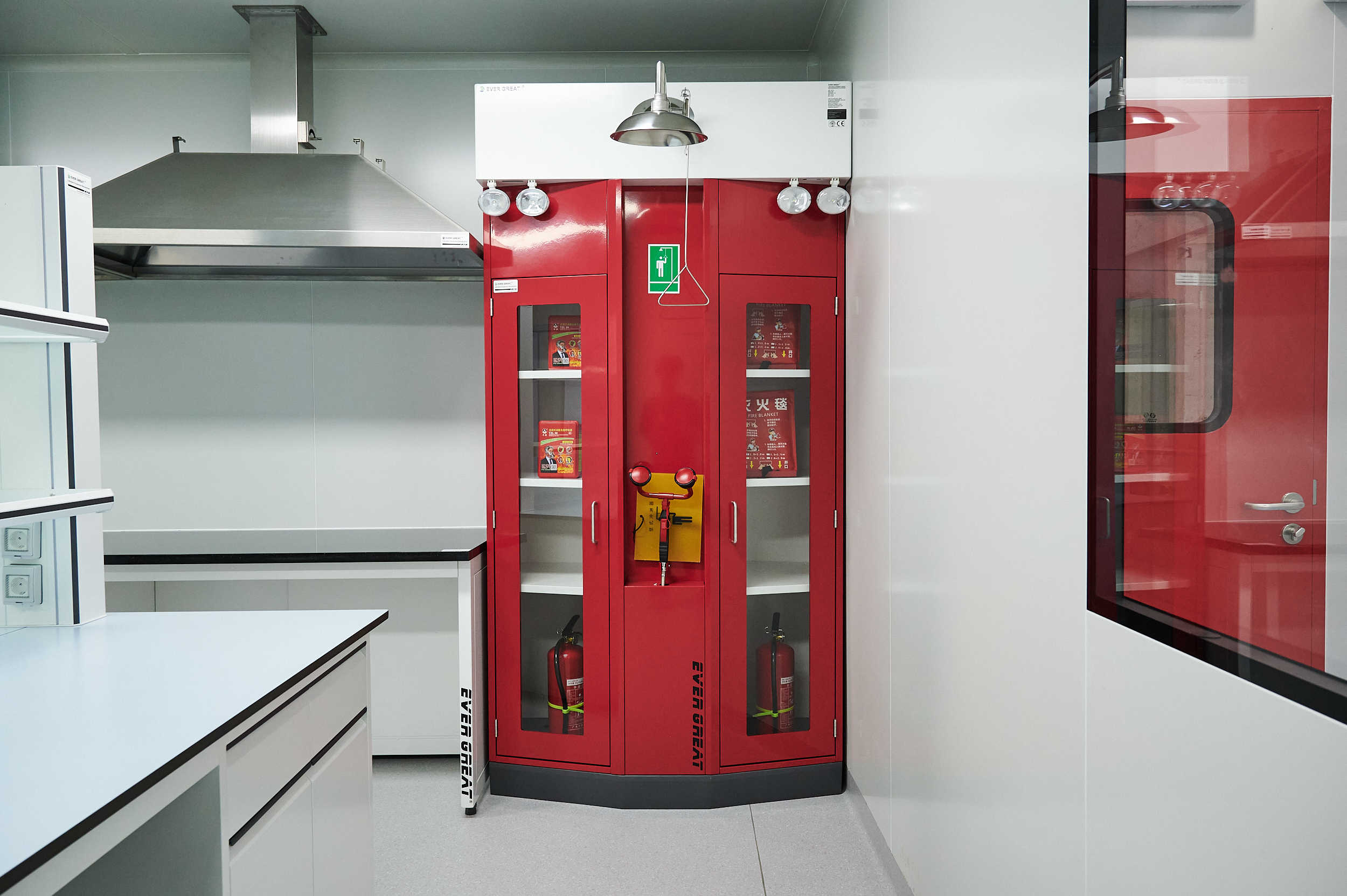
A ranked list of laboratory safety cabinets and benches should start with one uncomfortable question: if this unit fails, what happens next? A flammable storage cabinet that loses its double-wall barrier releases a fire load into the room. An unrestrained gas cylinder becomes a projectile. A fume hood that cannot hold face velocity exposes the operator on the next hood work session. Ranking by price or by visual weight answers the wrong question.
This ranking covers ten containment, storage, emergency, and benching products supplied by Guangdong Ever Great Laboratory Equipment Co., Ltd. (Ever Great), a laboratory infrastructure manufacturer founded in 2011 and based in Shishan Town, Nanhai District, Foshan City, Guangdong Province, China. The ten items are ranked by safety criticality for chemical, pharmaceutical, and industrial-gas laboratories, using only published product data, certificate records, and project references held by the manufacturer. No third-party brand is ranked here, and no competitor specification is asserted, because unverifiable comparison claims are worth less than no comparison at all.
What Makes a Laboratory Cabinet or Bench Decision Safety-Critical
A safety-critical purchase is decided by four constraints, and each one can disqualify a product before price is discussed: hazard class, material compatibility, ventilation dependence, and documented compliance.
Hazard class. Flammable liquids, corrosive acids and bases, and compressed gases behave differently in a fire, in a spill, and in a leak. They cannot be stored in the same cabinet type, and they cannot be stored in the same cabinet.
Material compatibility. The most common specification error in laboratory furniture is storing concentrated acids in a coated steel cabinet or storing flammable solvents in a polypropylene cabinet. Steel corrodes under acid vapor; polypropylene has no fire-resistance role. Material and hazard must be matched deliberately.
Ventilation dependence. A vented cabinet without a real exhaust path is a storage box with a hole in it. An exhaust port, a canopy diameter, and a face velocity figure are only meaningful when the building side of the system exists and is balanced.
Documented compliance. For export projects, the question is not whether a supplier says a product is compliant, but which certificate number covers which model designation, issued by which body, for which market, valid until which date. That paper trail is the constraint that governs most European and North American procurement.
Industry Background: Market Scale, Material Split, and Governing Standards
Commercial research from Dataintelo places the global laboratory furniture market — workbenches, fume hoods, cabinets, and seating — at approximately USD 4.8 billion in 2025, with a projected value of USD 8.1 billion by 2034. The same research house reports that metal furniture held a 52.7% revenue share of the material segment in 2025. Both figures should be read as directional: published 2025 estimates for the same category vary substantially between research houses, largely because some definitions include integrated laboratory services and high-end components such as gas piping while others count core furniture only.
The practical takeaway from the material split is not that metal dominates, but that the metal majority leaves a specific gap. Chemical-intensive laboratories that handle concentrated acids and alkalis need all-polypropylene or stainless construction in the areas where metal would corrode. That is why the ranking below includes both coated steel and polypropylene items, in that order of application rather than in order of preference.
Three standards shape how buyers specify this category. ANSI/ASHRAE Standard 110-2016 (R2025) is the primary American national standard defining the quantitative and qualitative test method for evaluating fume containment of laboratory fume hoods. EN 14470-1 is the European standard for fire safety storage cabinets for flammable liquids, classifying cabinets as Type 15, 30, 60, or 90 by the time taken for the internal temperature to rise beyond the limit defined in the standard — an internal temperature increase that should not exceed 180 K or 200 °C. EN 14175 is the European fume hood standard referenced in Ever Great's containment testing programme, alongside ASHRAE 110, with third-party test reports from inspection bodies including SGS.
On the supply side, China exported over USD 4.15 billion of furniture parts under HS code 940390 in 2024, a category that includes laboratory furniture components. Buyers comparing laboratory furniture manufacturers are therefore selecting inside a deep and heavily documented supplier market, which makes specification discipline the deciding factor rather than availability.
How This Ranking Was Built
Each of the ten items was assessed against five criteria, and the criteria are weighted by consequence rather than by cost:
- Consequence of failure — what the item protects against when it performs, and what it releases when it does not.
- Containment provision density — the number of engineered provisions built into the unit, such as double-wall construction, spill sumps, exhaust connections, purging, and restraint.
- Material and hazard fit — whether the construction material is chemically or thermally appropriate for its stated application.
- Documentation — whether the item sits inside a traceable certification or test record, with a certificate number and an identified issuing body.
- Integration into a working lab — whether the item connects to exhaust, alarm, utility, or emergency systems rather than standing alone.
Ranks 1 to 5 are storage and containment items where failure has the highest consequence. Ranks 6 to 8 are active work zones and wash stations where exposure risk concentrates during operations. Ranks 9 and 10 are structural work surfaces that determine whether the containment items can be positioned correctly in the first place.
The Top 10 Laboratory Safety Cabinets and Benches, Ranked
1. Flammable Safety Cabinet — EG-SF-LB005
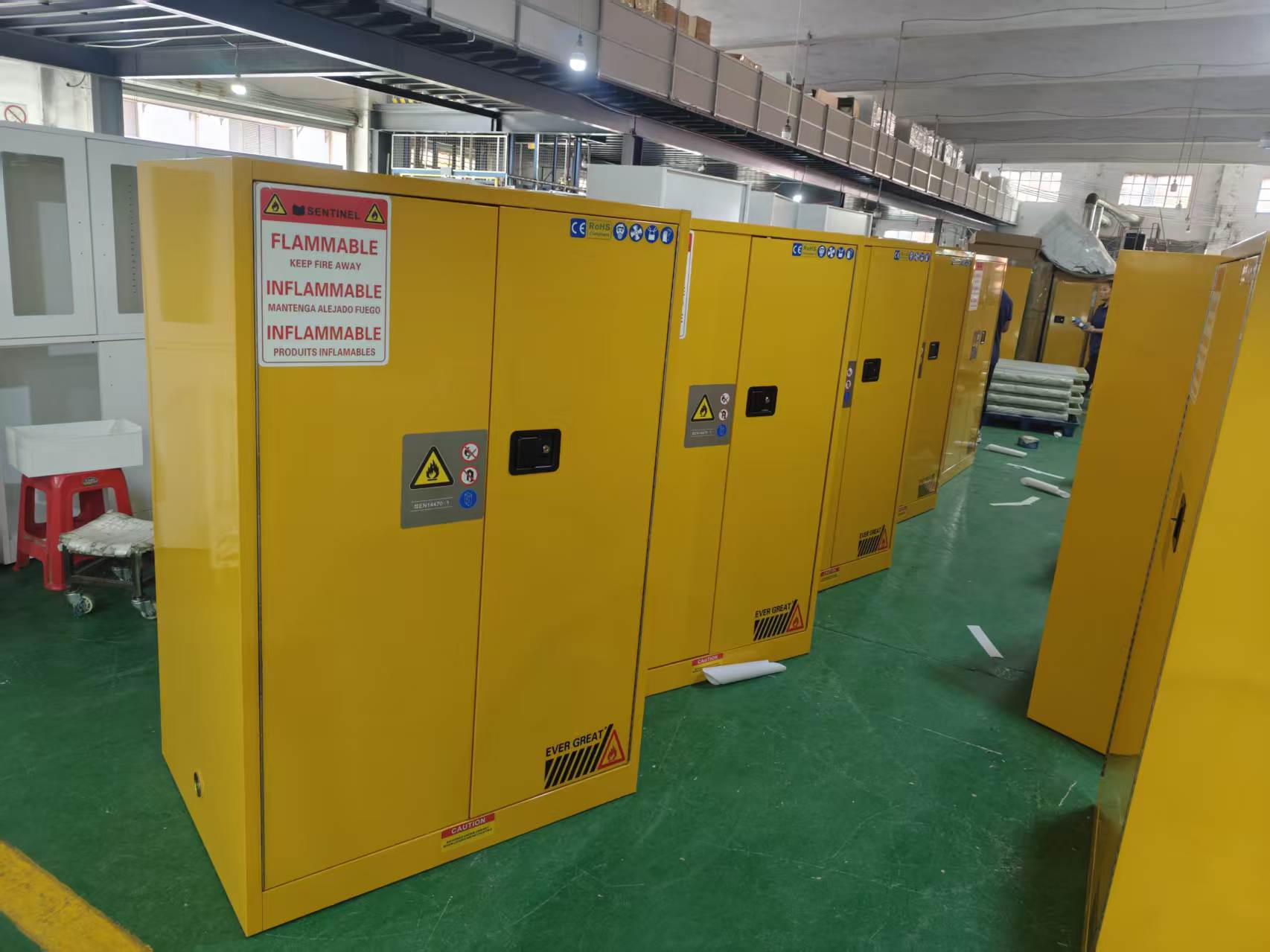
A yellow fireproof chemical safety cabinet with a nominal capacity of 45 gallons, external dimensions of 1090 × 460 × 1650 mm, 1.2 mm double-wall steel construction, a 38 mm air barrier between the walls, a 51 mm sump, and dual flash-arrested vents. It uses a three-point latch, a grounding provision, and adjustable galvanized shelves on zinc-plated hardware, and is intended for chemical, manufacturing, and laboratory chemical-storage areas.
It ranks first because flammable liquid storage combines the highest consequence of failure with the densest set of engineered provisions in the product family: the double-wall shell and air barrier create the thermal break, the sump catches a container failure, and the flash-arrested vents manage internal pressure without offering a flame path. The documentation trail is also the most complete, which matters when a project is audited.
The CE Certificate of Conformity for the Flammable Safety Storage Cabinet, Model FB-03, carries certificate number TH2310049-C01-C01 and was issued by Shenzhen Tian Hai Test Technology Co., Ltd. for the EU market, citing EN IEC 60079-0:2018, EN 60079-1:2014, EN IEC 60079-7:2018, EN 60079-11:2012, EN IEC 60079-15:2019, EN 60079-18:2015, EN 60079-14:2014, and EN 60529:1992. A separate RoHS Attestation of Conformity under (EU) 2017/2102 Restriction of Hazardous Substance carries certificate number TH2310049-C02-C01 from the same issuing body.
2. Gas Cylinder Safety Cabinet — EG-S0-CB005
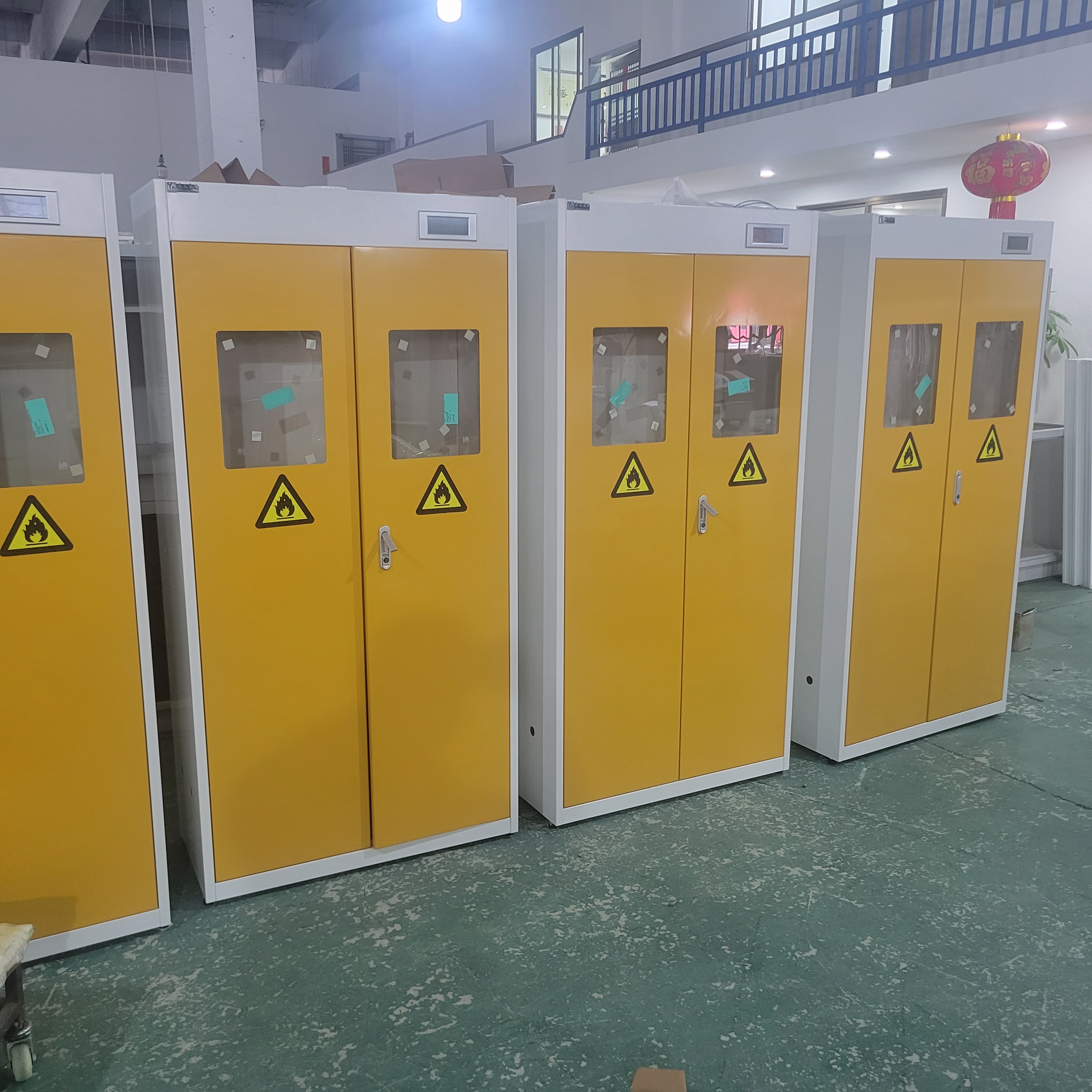
A steel gas cylinder cabinet with a purging system, measuring 900 × 450 × 2000 mm and constructed from 1.0 mm cold-rolled steel with powder coating. It is available in single-, double-, and triple-cylinder configurations and is intended for chemical, semiconductor, and industrial-gas laboratories.
It ranks second because compressed gas carries stored energy that does not dissipate. The three provisions that matter most are all present: cylinder-fixing provisions to restrain the cylinder body, an anti-tip layout so the cabinet cannot be pulled over by a hose load, and an alarm/exhaust linkage configuration that ties the cabinet to the room's gas detection rather than leaving it as a passive enclosure. An automatic purging option is available where residual gas must be cleared before access.
In a gas lab, this cabinet is not a storage accessory — it is the interface between the cylinder and the building's safety systems. Specify the purge and linkage options at the same time as the exhaust design, not after.
3. Laboratory Safety and Emergency Hub — EG-SF-CB011
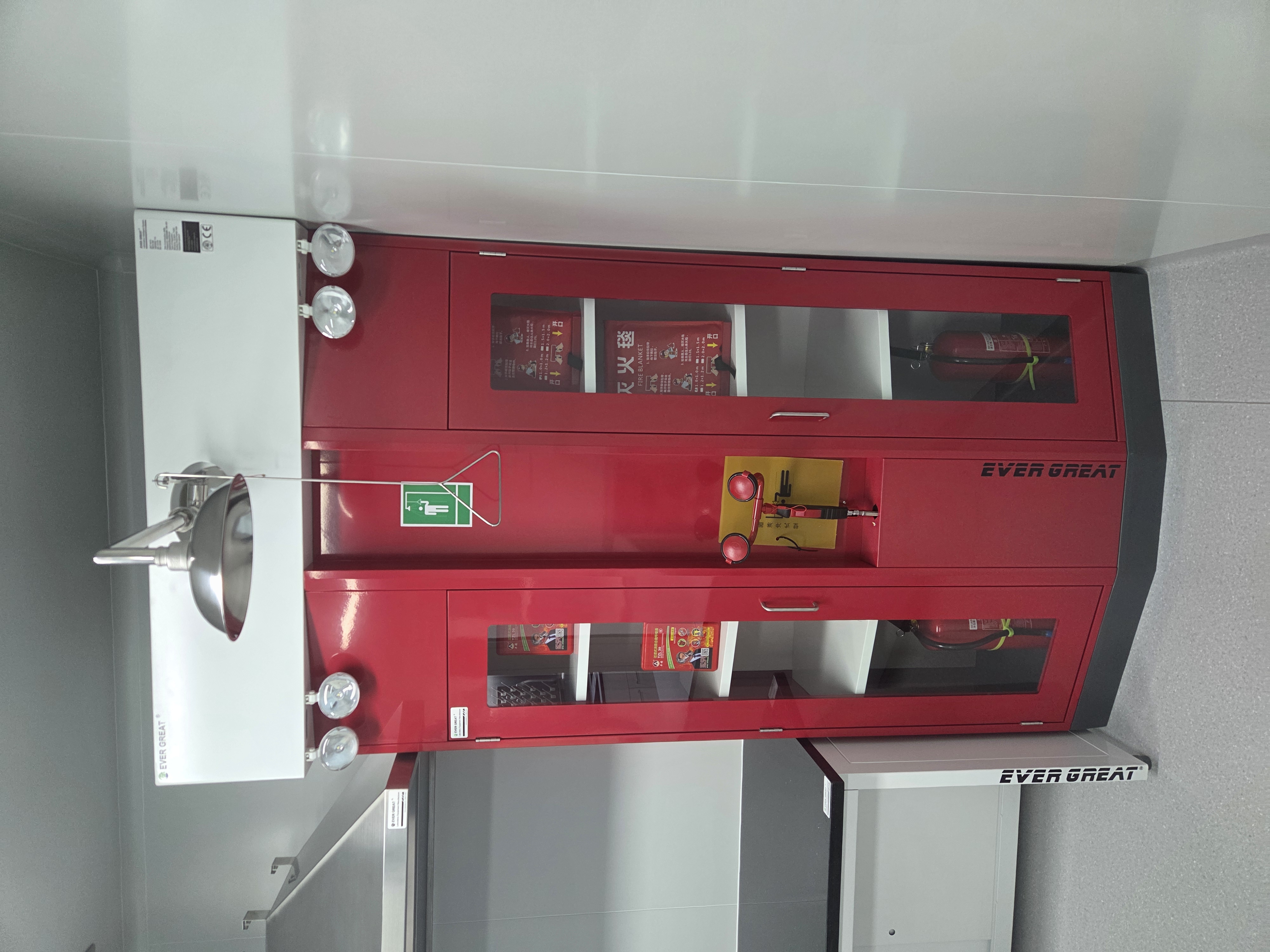
An integrated emergency safety cabinet measuring 900 × 600 × 2000 mm, built from 1.0 mm cold-rolled steel with epoxy powder coating and an aluminum handle. It consolidates an integrated shower, eyewash, first-aid, and fire-safety storage into a single unit, and includes a leak-sensing configuration with alarm integration capability. It is intended for education, pharmaceutical, and chemical laboratories.
No other item in this list acts after an exposure has already happened. It ranks third because the distance between a spill and an eyewash is measured in seconds, and consolidating shower, eyewash, first aid, and fire-safety equipment into one footprint removes the most common failure in emergency planning: equipment distributed across a room, behind doors, or blocked by stored goods. The leak-sensing configuration and alarm integration capability mean the hub reports incidents as well as responds to them.
Placement rule: mount it on the exit path, not in a corner behind a bench. An emergency hub that must be located by memory under stress is an emergency hub that will be misused.
4. Vented Chemical and Reagent Cabinet — EG-S0-LB001
A full-steel exhausted chemical cabinet measuring 900 × 500 × 1800 mm with double-wall steel construction, four adjustable shelves, and a Ø110/150 mm exhaust connection. It uses an epoxy coating and tempered glass, has adjustable spill-retaining shelves, and is intended for chemical, pharmaceutical, and analytical laboratories.
It ranks fourth because it addresses vapor rather than fire. Reagent storage generates continuous low-level vapor, and an exhausted cabinet moves that vapor out of the breathing zone instead of letting it accumulate each time the door opens. The Ø110/150 mm connection is the specification that determines whether the cabinet can be commissioned at all — if the room has no exhaust path of that dimension with sufficient capacity, this cabinet cannot perform its function and should not be ordered.
This is a coated-steel product and is intended for reagent classes compatible with an epoxy-coated interior. Aggressive acid storage belongs in the next item on this list.
5. PP Acid and Alkali Storage Cabinet — EG-PP-CB003
A metal-free corrosive chemical storage cabinet measuring 900 × 450 × 1800 mm, constructed from 8.0 mm polypropylene sheet with PP hardware, three adjustable spill-containment shelves, a bottom sump, and a Ø110 mm exhaust port. It is intended for chemical, electroplating, and acid-alkali laboratories.
It ranks fifth because it solves the single most common material mismatch in laboratory storage. Concentrated acids and bases attack coated steel; the corrosion begins at cut edges and hardware, then spreads behind the coating where inspection cannot reach it. An all-polypropylene, metal-free structure removes the corrosion couple entirely, while the seamless welding approach and PP hardware eliminate metallic fasteners as a failure point. Three spill-containment shelves and a bottom sump address the drip path, and the Ø110 mm exhaust port allows the cabinet to be tied into the same exhaust strategy as the vented reagent cabinet.
Honest limitation: polypropylene is a corrosion solution, not a fire-resistance solution. Do not substitute this cabinet for a flammable safety cabinet.
6. Polypropylene Fume Hood — EG-PP-FH
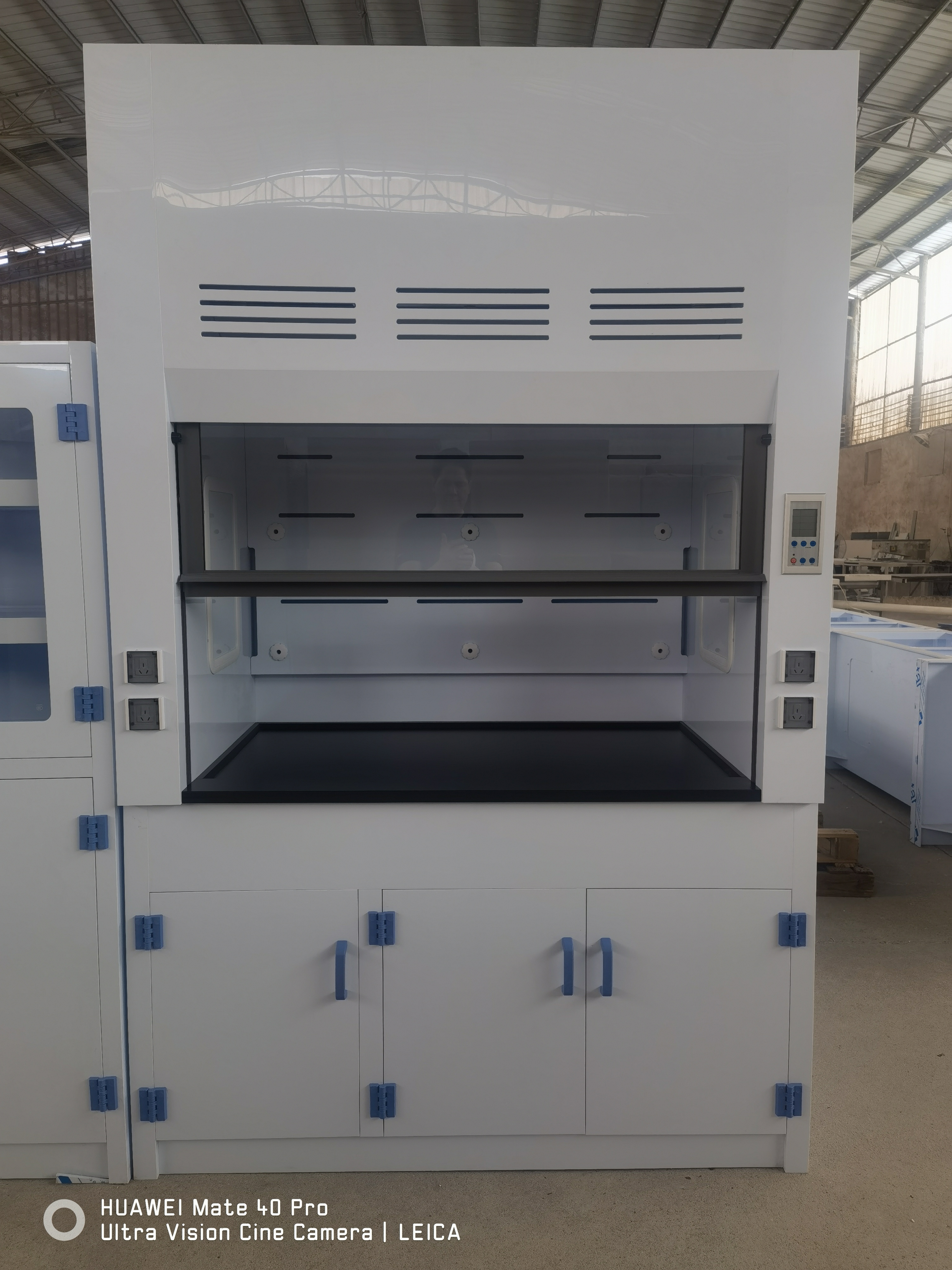
A seamless-welded polypropylene anti-corrosion fume hood available in 1200, 1500, and 1800 mm widths, all 850 mm deep and 2350 mm high. Polypropylene sheet thickness is 8.0 mm or greater, face velocity is specified at 0.3–0.6 m/s, and the unit uses a three-stage baffle. The material set is homogeneous PP with PP welding rod and tempered glass; the body is all-PP with an optional ceramic worktop, and the hood is intended for chemical, electroplating, and acid-alkali laboratories, with a corrosion-resistant process area suited to petrochemical applications.
It ranks sixth as the first active containment work zone. The design choice is deliberate: when the dominant chemistry is acid and alkali, a welded polypropylene body outlasts a coated metal interior, and the seamless construction removes the joints where vapor attack normally begins. The three-stage baffle is the component that converts face velocity into actual containment across the working depth, and the 0.3–0.6 m/s band is the range a commissioning test must verify.
7. Narrow-Frame Fume Hood, Benchtop and Walk-In — Orion-TS-1500 / Orion-TS-1800 / Orion-LD-1500 / Orion-LD-1800
A benchtop and walk-in fume hood family offered in 1500 and 1800 mm widths, 900 mm depth, and 2400 mm height, with internal widths of 1408 mm and 1708 mm respectively. Nominal face velocity is 0.3 m/s, the PP exhaust canopy is available at Ø250/315 mm, and the construction uses an aluminum alloy frame with a PP exhaust canopy. The hood is intended for chemical, pharmaceutical, and R&D laboratories and offers benchtop and walk-in configurations with a VAV/CAV-ready configuration path.
It ranks seventh because it is the platform that R&D and pharmaceutical labs actually run their daily work inside. The narrow-frame viewing area improves visibility of the work zone without reducing internal width, the walk-in configuration accommodates tall apparatus and distillation assemblies that will not fit a benchtop hood, and the VAV/CAV-ready path means the unit can be integrated with a variable or constant air volume control strategy instead of being locked to a fixed airflow. For projects specifying EN 14175 or ASHRAE 110 containment testing regimes, this is the hood family to place in the test scope.
8. Exhaust Washing Bench — EG-SS-LG002
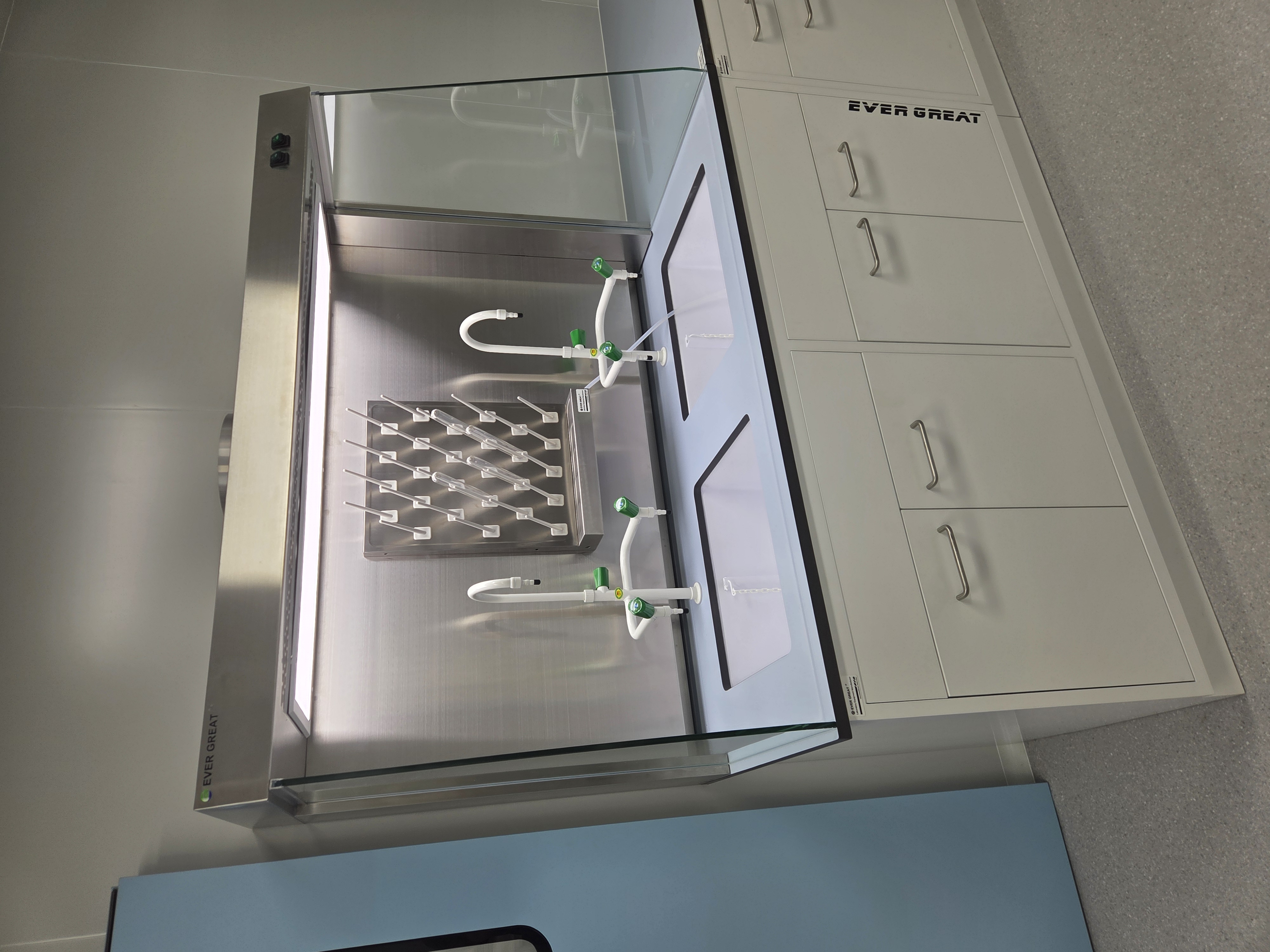
A stainless steel canopy sink bench measuring 1500 × 750 × 1500 mm with a 25 mm ceramic worktop, two PP sinks, and two three-way gooseneck faucets. The material set is full steel, 304 stainless steel, PP sinks, and a ceramic worktop, and the unit is intended for chemical, pharmaceutical, and QC laboratories.
It ranks eighth because the sink is where acid handling concentrates. Glassware is rinsed, solutions are diluted, and spills happen at the point of washing — which is exactly where vapor is generated and where operators lean in closest. Combining washing and local exhaust functions in one bench means the canopy captures vapor at the source rather than relying on general room ventilation, the 304 stainless steel hood resists the wet environment, and the 25 mm ceramic worktop takes both chemical attack and thermal shock. Two sinks and two three-way gooseneck faucets allow two operators to work simultaneously without sharing a rinse point.
9. Island Laboratory Bench — EG-S0-CB005
A full-steel central workstation available in 3000 mm and 3600 mm lengths, 1500 mm depth, and 850 mm height, constructed from 1.0–1.2 mm steel with a choice of 12.7 mm phenolic, 20 mm ceramic, or epoxy resin worktops, and 220V/10A sockets. It uses a modular workstation layout with utility integration, and optional accessories include a reagent rack and PP sink. It is intended for research institutes, universities, and pharmaceutical laboratories.
It ranks ninth because layout determines whether containment equipment can be used correctly. A central island keeps circulation around the bench rather than against a wall, gives each workstation access to power and utilities, and allows the storage cabinets in this list to be positioned within reach of the work rather than behind the operator. The worktop decision is a specification decision, not a preference: phenolic for general and physical work, ceramic where thermal shock and severe chemical exposure dominate, epoxy where impact and cost efficiency matter most.
10. C-Frame Wall Laboratory Bench — EG-S0-LB003
A suspended C-frame wall bench available in 1200, 1500, and 1800 mm lengths, 750 mm depth, and 850 mm height, built from 40 × 60 × 1.8 mm high-carbon steel tube with a 12.7 mm phenolic worktop. The suspended C-frame design leaves the floor beneath the bench clear, and it is intended for education, testing, and industrial laboratories.
It ranks tenth because it is the support surface rather than the containment device — but it earns its place by solving two practical problems that affect safety performance indirectly. The suspended frame makes cleaning below the bench straightforward, which reduces the accumulation of spilled material under workstations, and the open configuration allows flexible base cabinet placement, so storage can be moved as the chemical inventory changes. For high-throughput teaching and testing labs, where bench count and cleaning time dominate operations, this is the most efficient perimeter bench in the family.
Ranking at a Glance: Comparison Table
| Rank | Product and model | Primary hazard or function | Key verified provisions | Best-fit lab type |
|---|---|---|---|---|
| 1 | Flammable safety cabinet — EG-SF-LB005 | Flammable liquid storage; fire containment | 45 gal nominal; 1.2 mm double-wall steel; 38 mm air barrier; 51 mm sump; dual flash-arrested vents; three-point latch; grounding provision; CE and RoHS certificates on record | Chemical, manufacturing, laboratory chemical storage |
| 2 | Gas cylinder safety cabinet — EG-S0-CB005 | Compressed gas storage; restraint and purge | 900 × 450 × 2000 mm; 1.0 mm cold-rolled steel; single/double/triple cylinder options; cylinder-fixing provisions; anti-tip layout; alarm/exhaust linkage; automatic purging option | Chemical, semiconductor, industrial gas |
| 3 | Laboratory safety and emergency hub — EG-SF-CB011 | Post-exposure response; emergency equipment consolidation | 900 × 600 × 2000 mm; 1.0 mm cold-rolled steel; integrated shower, eyewash, first-aid and fire-safety storage; leak-sensing configuration; alarm integration capability | Education, pharmaceutical, chemical |
| 4 | Vented chemical and reagent cabinet — EG-S0-LB001 | Reagent vapor control | 900 × 500 × 1800 mm; double-wall steel; four adjustable shelves; Ø110/150 mm exhaust connection; epoxy coating; tempered glass; spill-retaining shelves | Chemical, pharmaceutical, analytical |
| 5 | PP acid and alkali storage cabinet — EG-PP-CB003 | Corrosive acid and base storage | 900 × 450 × 1800 mm; 8.0 mm PP sheet; metal-free all-PP structure; three adjustable spill-containment shelves; bottom sump; Ø110 mm exhaust port | Chemical, electroplating, acid-alkali |
| 6 | Polypropylene fume hood — EG-PP-FH | Active containment work zone for corrosive chemistry | 1200/1500/1800 × 850 × 2350 mm; PP sheet ≥8.0 mm; face velocity 0.3–0.6 m/s; three-stage baffle; seamless-welded all-PP body; optional ceramic worktop | Chemical, electroplating, acid-alkali, petrochemical |
| 7 | Narrow-frame fume hood — Orion-TS-1500/1800, Orion-LD-1500/1800 | Containment for R&D and pharmaceutical work | 1500/1800 × 900 × 2400 mm; internal width 1408/1708 mm; nominal face velocity 0.3 m/s; PP exhaust canopy Ø250/315 mm; benchtop and walk-in; VAV/CAV-ready path | Chemical, pharmaceutical, R&D |
| 8 | Exhaust washing bench — EG-SS-LG002 | Washing plus local exhaust at the spill point | 1500 × 750 × 1500 mm; 25 mm ceramic worktop; two PP sinks; two three-way gooseneck faucets; 304 stainless steel hood | Chemical, pharmaceutical, QC |
| 9 | Island laboratory bench — EG-S0-CB005 | Central workstation with integrated utilities | 3000/3600 × 1500 × 850 mm; 1.0–1.2 mm steel; 12.7 mm phenolic, 20 mm ceramic or epoxy worktop options; 220V/10A sockets; optional reagent rack and PP sink | Research institutes, universities, pharmaceutical |
| 10 | C-frame wall laboratory bench — EG-S0-LB003 | Perimeter work surface; clean-under design | 1200/1500/1800 × 750 × 850 mm; 40 × 60 × 1.8 mm high-carbon steel tube; 12.7 mm phenolic worktop; suspended C-frame | Education, testing, industrial |
Step-by-Step Breakdown: Specifying These Ten Items for a Live Project
Step 1 — Build the chemical inventory first. List the ten highest-volume chemicals, every compressed gas cylinder on site, and the acids used at the bench. Storage class is decided by this list, not by the room dimensions. Flammables, corrosives, and gases must be separated into different cabinet types before any quotation is requested.
Step 2 — Match material to hazard. Coated steel for flammable storage (EG-SF-LB005) and for reagent vapor control (EG-S0-LB001); all-polypropylene and metal-free for concentrated acid and base storage (EG-PP-CB003) and for acid-heavy hood work (EG-PP-FH); 304 stainless steel and ceramic where washing and wet corrosion dominate (EG-SS-LG002). The correct answer is the material that survives the specific inventory, not the material with the broadest claim.
Step 3 — Map the exhaust path before ordering anything. Three connection points drive the ventilation design: the Ø110/150 mm exhaust connection on the vented chemical and reagent cabinet, the Ø110 mm exhaust port on the PP acid and alkali storage cabinet, and the Ø250/315 mm PP exhaust canopy on the narrow-frame fume hood. The polypropylene fume hood requires 0.3–0.6 m/s face velocity and the narrow-frame hood is specified at a nominal 0.3 m/s. The gas cylinder cabinet adds a control interface through its alarm/exhaust linkage configuration and automatic purging option. If the building cannot supply these connections, the specification must change — not the installation date.
Step 4 — Lock the layout. Confirm cylinder-fixing provisions and the anti-tip layout for the gas cylinder cabinet, aisle clearance around the 3000/3600 mm island bench, and the placement of the emergency hub on the exit path with the shower and eyewash reachable from the working positions. Where a C-frame bench is used, verify the clear floor beneath it is kept clear so the cleaning benefit is realised.
Step 5 — Verify documentation against the order. Check that each certificate number matches the model designation being ordered, that the issuing body and market scope are stated, and that validity dates cover the project timeline. For fume hood containment, request the test report rather than a test claim. For flammable storage, state the required EN 14470-1 class if the project fire strategy defines one.
Step 6 — Confirm delivery, installation, and after-sales scope. Ever Great operates OEM/ODM production with a monthly capacity of 2,000 units, a minimum order quantity of 1 unit, and a lead time of 10–30 days, with 100% testing. Export packing uses knock-down mortise-and-tenon pre-assembly, heavy-duty export plywood crating with vacuum foil wrap, and a 100% pre-assembled test fit before shipment. Installation support includes 3D modular assembly video guides, colour-coded hardware labelling, spare parts backup in the container, and remote engineer guidance. The stated warranty is 1 year comprehensive, with lifetime remote or on-site engineering support.
Use Cases: How the Ranking Shifts by Lab Type
Chemical and petrochemical laboratories. Here the ranking holds close to its default order, with one adjustment: polypropylene moves up. In a high-risk acid digestion environment, the working conditions include heavy acid exhaust from HCl, HNO3, and HF, high temperature, and continuous airflow in an indoor hazardous zone, with 24/7 exhaust and VAV or CAV automatic control, and a specification requirement that includes EN 14175 or ASHRAE 110 compliance with a seamless PP inner liner or ceramic worktop and explosion-proof lighting. In that setting ranks 5, 6, and 8 carry the daily load, and the vented reagent cabinet (rank 4) supports the analytical bench.
Pharmaceutical and R&D laboratories. The balance shifts toward ranks 7, 9, and 10, supported by storage. A pharmaceutical lab expansion typically pairs benchtop and walk-in narrow-frame hoods with island and wall benches, adds the vented reagent cabinet and the glassware drying and storage cabinet, and places the emergency hub (rank 3) on the exit path. Where the facility also includes a controlled cleanroom environment — for example an ISO Class 5 to Class 8 space with positive pressure and HEPA filtration — stainless work surfaces and the vented cabinet take priority over the polypropylene items.
Industrial gas and semiconductor laboratories. Rank 2 becomes the lead item. Single-, double-, and triple-cylinder cabinet configurations allow the inventory to match the site, and the alarm/exhaust linkage plus the automatic purging option integrate with the room's gas detection and exhaust controls. The flammable safety cabinet (rank 1) remains in the same project for solvent storage.
Metallurgical and heavy testing laboratories. Extreme temperature, heavy mechanical impact, oil and grease exposure, and high vibration change the priority order again. Stainless 304/316 surfaces and heavy-duty benches move up, with local extraction arms used alongside the hoods, while the vented reagent cabinet and gas cylinder cabinet support sample preparation and instrument gas supply.
Education and high-throughput testing laboratories. Rank 10 becomes the workhorse. A university and educational research facility project in India involving 255 units, a clinical diagnostics and healthcare laboratory project in China involving 200 units, a metallurgical and smelting laboratory project in the Philippines involving 105 units, a food safety and QA/QC laboratory project in Australia involving 45 units, and a clinical diagnostics laboratory project in Tanzania involving 30 units all rely on a mix dominated by perimeter and island benches, with safety cabinets and emergency hubs sized to the number of students or operators rather than to process volume. In each of these completed projects, the stated outcome was that laboratory personnel could carry out their daily work in the furnished space.
Frequently Asked Questions
Which certifications should a chemical or pharmaceutical lab verify before buying safety cabinets and fume hoods?
Verify four document groups. First, fume hood electrical compliance: fume hood models EG-FH01, EG-FH04, EG-FH02, EG-FH03, and EG-FH06 are certified to the EMC Directive 2014/30/EU under certificate number CKEYS251020088, issued by Guangdong KEYS Testing Technology Co., Ltd. for the EU/EEA market, issued 20 October 2025 and valid to 20 October 2035, citing EN IEC 61000-6-2:2019, EN IEC 61000-6-4:2019, EN IEC 61000-3-2:2019+A1:2021+A2:2024, and EN 61000-3-3:2013+A1:2019+A2:2021. Second, flammable cabinet CE certification: the Flammable Safety Storage Cabinet, Model FB-03, holds CE Certificate of Conformity TH2310049-C01-C01 issued by Shenzhen Tian Hai Test Technology Co., Ltd. for the EU market, and RoHS Attestation of Conformity TH2310049-C02-C01 under (EU) 2017/2102. Third, management systems: ISO 9001 quality management and ISO 14001 environmental management certification. Fourth, containment performance: fume hoods are tested against EN 14175 and ASHRAE 110 benchmarks with third-party reports from inspection bodies including SGS. Where a project fire strategy requires a defined fire-resistance duration, request the EN 14470-1 class as well; where a material reaction-to-fire classification is required, request the applicable documentation rather than a verbal statement. Always confirm that the model designation on the certificate matches the designation on the purchase order.
Can Ever Great customize fume hoods and safety cabinets for a specific chemical laboratory?
Yes. Ever Great operates in OEM/ODM production mode with three customization scopes: technical and specification customization, OEM and white-label production, and R&D with prototyping. Specification customization is the relevant route for chemical laboratories, because the ten items in this ranking already carry defined options that can be adapted to a project: the polypropylene fume hood is produced in 1200, 1500, and 1800 mm widths with an optional ceramic worktop; the narrow-frame fume hood family offers benchtop and walk-in configurations in 1500 and 1800 mm widths with internal widths of 1408 mm and 1708 mm; the island bench accepts 12.7 mm phenolic, 20 mm ceramic, or epoxy resin worktops and offers an optional reagent rack and PP sink; and the gas cylinder cabinet is built in single-, double-, and triple-cylinder configurations with optional automatic purging and alarm/exhaust linkage. Production capacity is 2,000 units per month with a minimum order quantity of 1 unit, and every unit is tested at 100% before shipment.
What actually drives the cost of a laboratory safety cabinet or bench system?
Cost is driven by five specification decisions rather than by brand tier. The first is material class: coated cold-rolled steel, 8.0 mm polypropylene sheet, or 304 stainless steel carry different material and fabrication costs, and all-polypropylene construction with PP hardware adds a further step because metal fasteners must be eliminated. The second is containment provision density: a double-wall shell with a 38 mm air barrier, a 51 mm sump, and dual flash-arrested vents costs more than a single-wall enclosure because the engineered provisions are the product. The third is ventilation interface: an exhaust connection or canopy of a defined diameter, and options such as automatic purging and alarm/exhaust linkage, add both hardware and control integration. The fourth is the worktop: 12.7 mm phenolic, 20 mm ceramic, and epoxy resin are different materials with different cost positions, and 25 mm ceramic on a washing bench sits at the higher end. The fifth is documentation and customization scope: certification coverage, third-party test reports, and non-standard dimensions all add cost. Unit prices are not published because the specification determines the price; the practical route is to fix the chemical inventory and the exhaust path first, then request a quotation against that specification.
Can we validate a flammable safety cabinet or fume hood with a sample unit before placing a full order?
Yes, and the process is structured to support it. The minimum order quantity is 1 unit, so a single validation unit can be ordered without committing to a batch. Every unit is tested at 100% before shipment rather than by sampling. For projects that need to confirm fit before installation, production uses knock-down mortise-and-tenon pre-assembly with a 100% pre-assembled test fit before shipment, and export packing uses heavy-duty export plywood crating with vacuum foil wrap. Installation validation is supported by 3D modular assembly video guides, colour-coded hardware labelling, spare parts backup supplied in the container, and remote engineer installation guidance. The stated after-sales coverage is a 1-year comprehensive warranty with lifetime remote or on-site engineering support.
What is the lead time, and how does a project get started?
The stated lead time is 10–30 days, with a monthly production capacity of 2,000 units and a minimum order quantity of 1 unit. The sequence that produces an accurate quotation is: supply the chemical inventory and gas cylinder list, confirm the exhaust connections available in the building (Ø110/150 mm for the vented chemical and reagent cabinet, Ø110 mm for the PP acid and alkali cabinet, Ø250/315 mm canopy for the narrow-frame fume hood), confirm the worktop option required, and state whether purge or alarm linkage options are needed on the gas cylinder cabinet. Ever Great is based in Shishan Town, Nanhai District, Foshan City, Guangdong Province, China, and exports to the USA, EU, Middle East, and Africa, with 60% of output exported. Production is OEM/ODM. To move from this ranking to a project specification, contact the team directly by email at qsjiang666@outlook.com, by telephone or WhatsApp at +86 158-0007-2469, or review the full product range at evergreatlab.com and in the downloadable product catalogue.
Conclusion: Ranking Is a Starting Point, Not a Specification
This ranking is ordered by what happens when a unit fails, and that ordering changes the moment a chemical inventory changes. The flammable safety cabinet (EG-SF-LB005) leads because its failure releases fire; the gas cylinder cabinet (EG-S0-CB005) follows because compressed gas failure releases energy; the emergency hub (EG-SF-CB011) takes third because it is the only item that performs after an exposure. Ranks 4 and 5 separate vapor control from acid corrosion, ranks 6 to 8 cover the working zones where exposure concentrates, and ranks 9 and 10 provide the bench structure that lets everything else be positioned correctly.
Most projects do not need all ten items — they need the correct five. The way to identify those five is to fix the chemical inventory and the exhaust path first, then match material to hazard, then verify certificate numbers against the model designations being ordered. Done in that order, laboratory furniture selection stops being a comparison of catalogues and becomes a defensible safety decision.
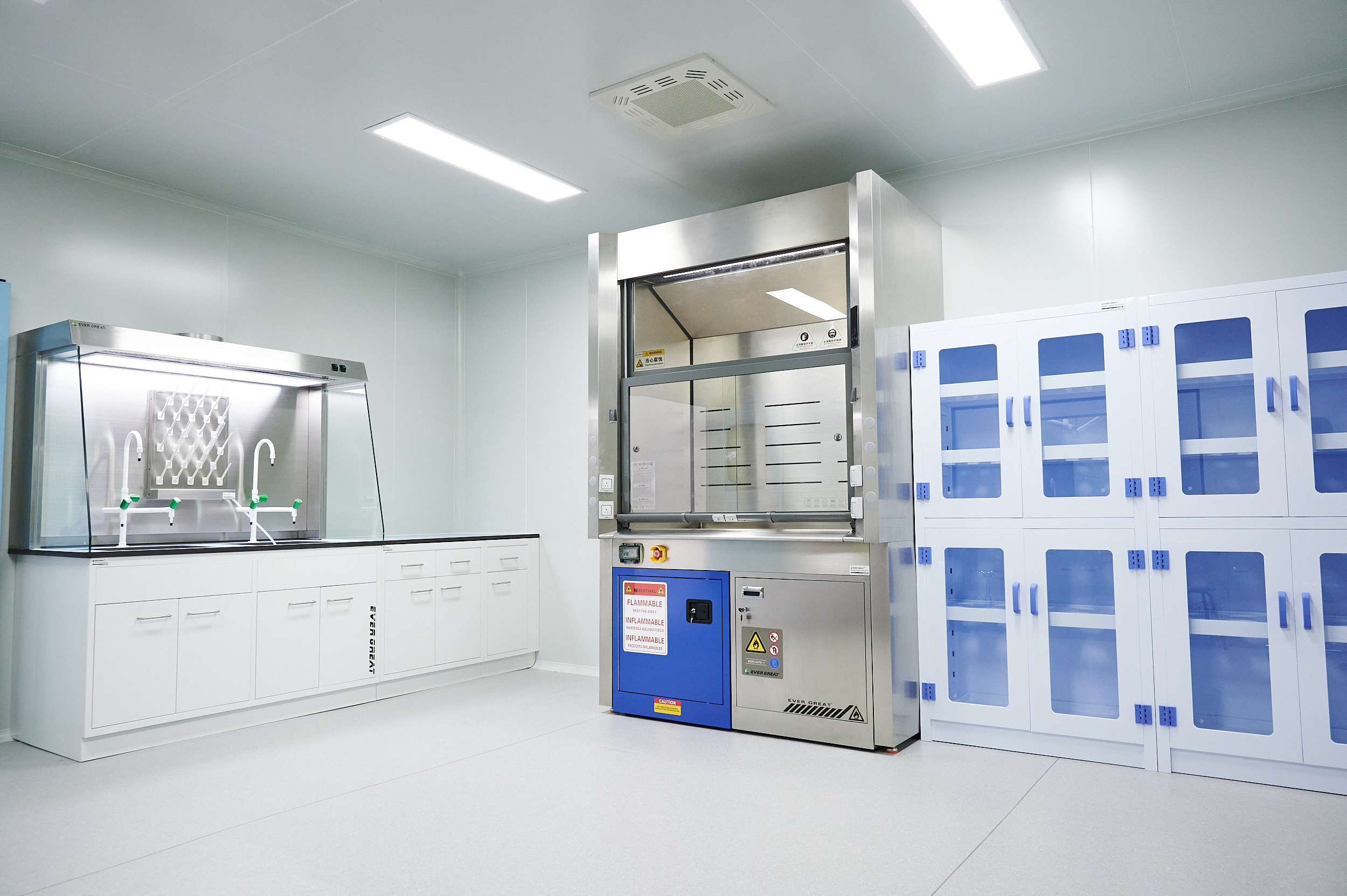
Next step: download the full Ever Great laboratory furniture catalogue, or send your chemical inventory, gas cylinder list, and available exhaust connections to qsjiang666@outlook.com / +86 158-0007-2469 (tel and WhatsApp) for a specification-matched quote. Product range: evergreatlab.com
Have Questions or Need More Details?
Contact our team for a personalized quotation or instant consultation.
Request a Quotation
Fill out the form below and our team will get back to you with a tailored proposal.
WhatsApp Direct Chat
Prefer to chat in real-time? Message us on WhatsApp for instant assistance & quick answers.
- Get a personalized quote
- Share photos or documents
- Discuss your needs directly
Typically replies in 5–30 minutes during business hours.