
Technical Guide to Selecting Exhaust Washing Benches for Lab Sink Areas
An exhaust washing bench is a wet-work station that combines a chemical-resistant worktop, one or more sinks, and a canopy or exhaust connection, so that washing, acid handling, and sample preparation take place under local ventilation instead of in open laboratory air. Four specifications decide whether a sink-area bench performs over its service life: worktop material and thickness, sink and faucet configuration, the overall bench envelope, and how the canopy connects to the room's exhaust system.
This guide uses one production platform as its reference point: the EG-SS-LG002 exhaust washing bench from Guangdong Ever Great Laboratory Equipment Co., Ltd. (Ever Great), a laboratory infrastructure manufacturer and EPC solutions provider founded in 2011 and based in Shishan Town, Nanhai District, Foshan City, Guangdong Province, China. The company supplies fume hoods, laboratory workbenches, safety storage cabinets, and PP and stainless steel laboratory furniture to chemical, pharmaceutical, QC, educational, and industrial laboratories. Every dimensional and material statement below comes from that platform's published product data or from cited third-party sources, so each specification can be checked line by line against a quotation or a submittal package.
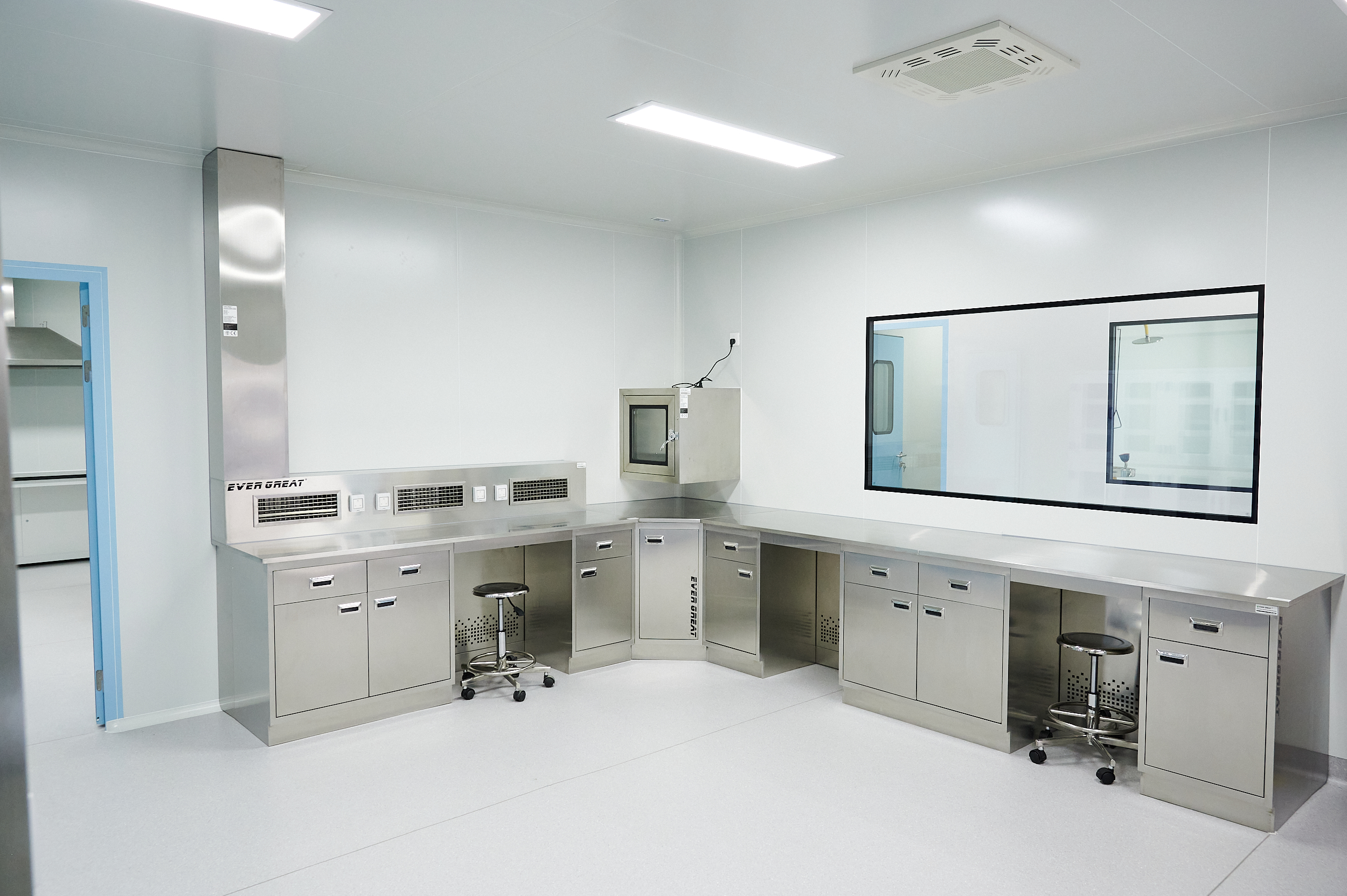
What Counts as an Exhaust Washing Bench
An exhaust washing bench is not simply a workbench with a sink cut into it. The category is defined by three features being present at the same time.
- A wet zone built from corrosion-tolerant components. On the EG-SS-LG002, the wet zone consists of two PP sinks set into a 25 mm ceramic worktop, with two three-way gooseneck faucets serving the two basins.
- A canopy or exhaust connection above the work surface. The platform is classified as a stainless steel canopy sink bench, which means the washing position sits beneath a canopy so that vapours released during washing and rinsing are captured close to the source rather than being diluted into room air.
- A load-bearing structure that survives permanent humidity. The declared material set is full steel, 304 stainless steel, PP, and ceramic. Stainless steel and polymer are placed where liquid contact is continuous, and coated steel is reserved for parts that stay dry.
The dimensional envelope of the reference unit is 1500 x 750 x 1500 mm. The 750 mm depth matches the depth family used across Ever Great's other bench platforms, such as the C-frame wall bench EG-S0-LB003 at 1200/1500/1800 x 750 x 850 mm, and the 1500 mm overall height positions the unit as a sink and canopy assembly rather than a seated workstation.
Why Lab Sink Areas Are the Hardest Zone to Specify
Sink areas concentrate failure mechanisms that dry benches never face. Corrosive liquid reaches cut-outs, drain collars, and bench edges continuously; splash lands on rear upstands and on the underside of canopies; and the vapour load from open washing is steady rather than occasional. In practice, sink-area problems surface in four ways.
1. Wet corrosion at cut-outs and joints
A sink cut-out is the point where the worktop's protective surface is interrupted. If cut-out edges and sealant lines are not executed properly, liquid migrates into the substrate and along the frame. This is why worktop material and edge sealing matter more on a washing bench than on a general-purpose bench.
2. Splash and drip damage on steel structures
Powder-coated steel is common in laboratory furniture, but a coating is a surface treatment, not a material. Where sustained splash is expected — which is essentially every working sink area — the specification should place stainless steel or polymer directly in the splash path and keep coated steel for the dry structural parts behind it.
3. Poor drainage and standing water
Laboratories frequently under-specify what happens to rinse liquid after use. A basin without a defined drip path pushes moisture onto adjacent surfaces, into base cabinetry, and onto the floor in front of the bench. Dedicated draining storage solves this directly. Ever Great's EG-SS-LB002, for example, is a 304 stainless steel draining cabinet measuring 900 x 500 x 1800 mm with four perforated shelves, a pull-out drip tray, and 5 mm tempered-glass doors.
4. Vapour released at the sink itself
Washing and rinsing release solvent and acid vapours at low but continuous rates. Without local capture at the sink position, those vapours are handled only by general room ventilation, which is far less efficient at the source. The canopy arrangement on an exhaust washing bench exists specifically to shorten that path.
Industry Background: Material Share, Trade Flow, and the Standards That Apply
Several external data points frame the specification decision. These are reported third-party figures rather than Ever Great measurements, and they are attributed so buyers can weigh them.
- Market size. Dataintelo's Laboratory Furniture Market Research Report 2034 values the global laboratory furniture market at approximately USD 4.8 billion in 2025. Read that figure with caution: research houses covering the same category have published 2025 estimates as low as roughly USD 1.14 billion, which suggests the difference lies mainly in market definition — core furniture versus integrated laboratory solutions. The direction of the market is a more reliable signal than any single number.
- Material mix. The same Dataintelo report puts the metal material segment at a 52.7% revenue share in 2025, meaning roughly half of laboratory furniture spending still goes to metal-based construction. For sink areas this matters, because the choice between a coated-steel frame with a stainless wet zone and a fully welded PP structure is exactly the decision that dominates wet-bench specification.
- Trade flow. OEC trade data shows China exported over USD 4.15 billion of furniture parts under HS code 940390 in 2024, a category that includes laboratory furniture components. This reflects how much laboratory furniture now moves across borders as components rather than as finished rooms.
- Containment and fire testing. ANSI/ASHRAE Standard 110-2016 (R2025) is the principal American national test method for evaluating fume containment in laboratory fume hoods. On the fire side, European standard EN 14470-1 classifies fire-resistant safety cabinets as Type 15, 30, 60, or 90 minutes according to the time taken for the internal temperature to rise past its limit, with a permitted internal temperature increase of no more than 180 K or 200 °C.
Wet washing benches have no single dedicated international performance standard the way fume hoods do. In practice they are specified through a combination of material requirements, drainage and containment details, and the containment performance of the ventilation equipment they connect to. That is why the equipment around the bench — the fume hood, the exhausted storage cabinet, the drying cabinet — carries most of the formal test documentation, while the bench itself is judged on materials, construction, and finish.
Detailed Solution: How the EG-SS-LG002 Exhaust Washing Bench Is Built
This section states the platform's confirmed specifications and explains what each one means for a sink-area layout.
Platform definition and envelope
The EG-SS-LG002 is a stainless steel canopy sink bench with an overall size of 1500 x 750 x 1500 mm. In layout terms, that width provides a two-basin wet zone without consuming the footprint of a full 1800 mm bench run, and the 750 mm depth keeps the unit compatible with the standard layout grid used for wall-side benches and service frames.
Worktop: 25 mm ceramic
The worktop is 25 mm ceramic. Ceramic is selected for bench surfaces where resistance to aggressive chemicals and to heat is the priority, and it is one of several worktop families offered across Ever Great's bench range. The island bench platform EG-S0-CB005 offers 12.7 mm phenolic, 20 mm ceramic, or epoxy resin worktops, while the C-frame wall bench EG-S0-LB003 uses a 12.7 mm phenolic worktop. At 25 mm, the ceramic surface on the washing bench is the thickest wet-zone worktop option in the reference range.
Wet zone: two PP sinks and two three-way gooseneck faucets
The bench carries two PP sinks and two three-way gooseneck faucets. Two basins allow washing and rinsing to be separated — a common requirement in chemical and QC workflows where cross-contamination between a dirty rinse and a final rinse must be controlled. Three-way gooseneck faucets suit sink positions where multiple services are delivered at one outlet point. The fixture type is stated in the platform data and should still be confirmed against the laboratory's utility plan during design, because the faucet specification follows from the services actually available at the wall.
Structural materials
The declared material set is full steel, 304 stainless steel, PP sink, and ceramic worktop. Read as a specification, that means the load-bearing structure is steel, stainless steel is used where corrosion resistance and cleanability matter, and the two surfaces in most direct contact with liquid — the sinks and the worktop — are PP and ceramic. This deliberate separation of structural material from wet-contact material is the main technical reason a washing bench costs more than an equivalent-length dry bench.
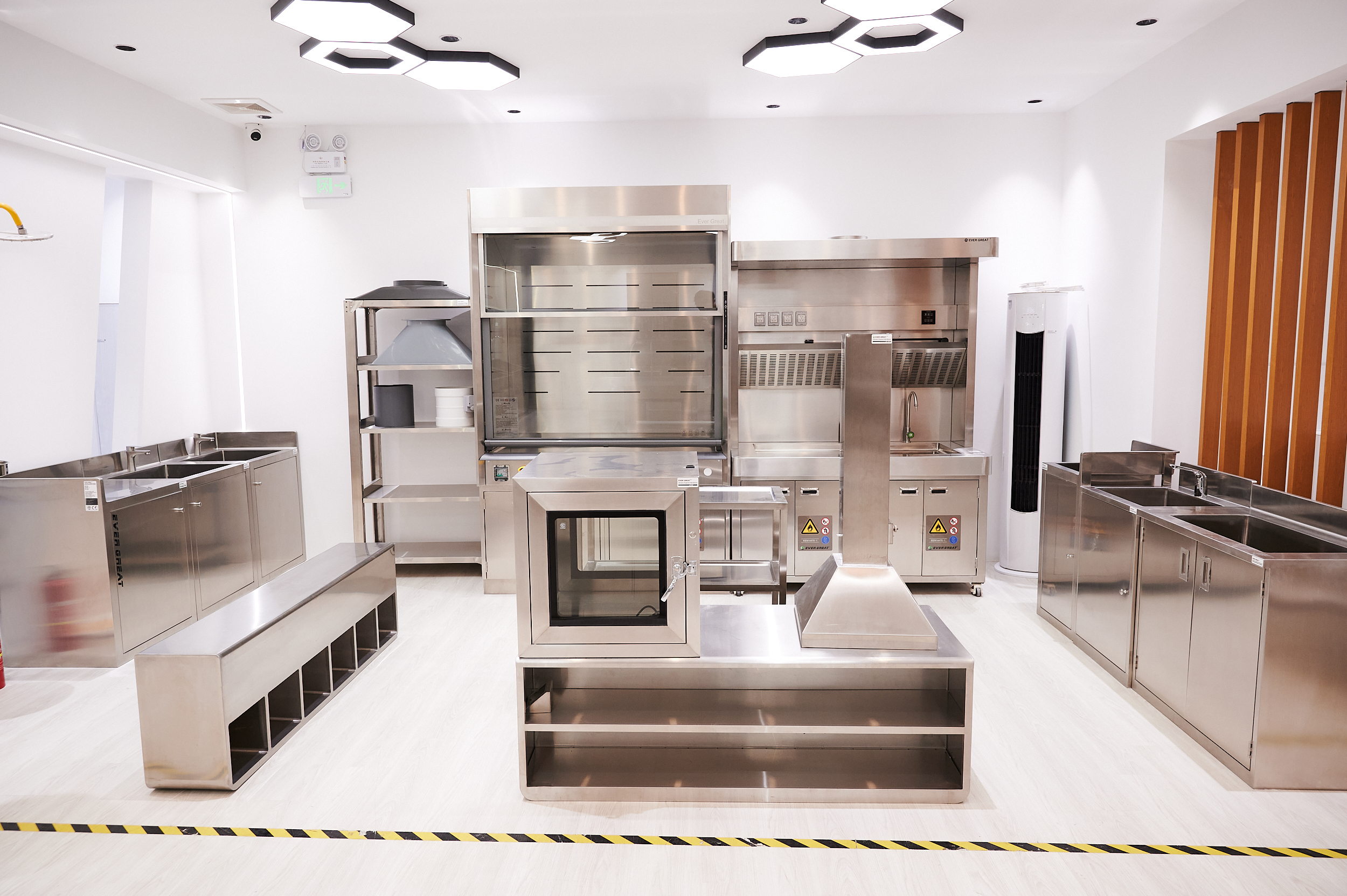
Canopy and exhaust integration
Because the platform is a canopy bench, the exhaust connection is part of the unit's design intent rather than an afterthought. Canopy size, duct route, and fan selection belong to the room's ventilation design and should be fixed in the same drawing set as the bench. For reference, adjacent ventilation products in the same portfolio are specified as follows: the vented chemical and reagent cabinet EG-S0-LB001 uses a Ø110/150 mm exhaust connection; the PP acid and alkali storage cabinet EG-PP-CB003 uses a Ø110 mm exhaust port; the polypropylene fume hood EG-PP-FH operates at a face velocity of 0.3–0.6 m/s with PP sheet thickness of 8.0 mm or more and a three-stage baffle; and the narrow-frame Orion benchtop and walk-in fume hoods use a Ø250/315 mm PP exhaust canopy with a nominal face velocity of 0.3 m/s. Planning the sink canopy against that same family of airflow criteria avoids having to re-balance the room later.
Compliance and quality documentation
Documentation is where a wet-bench specification is most often left vague. The verifiable points for this platform are as follows. Ever Great holds a RoHS Attestation of Conformity, certificate TH2310049-C02-C01, issued on 2023-10-13 by Shenzhen Tian Hai Test Technology Co., Ltd. and valid to 2028-10-13, assessed against (EU) 2017/2102 (Restriction of Hazardous Substances); the EG-SS-LG002 exhaust washing bench appears in that certificate's related product list. At company level, the management systems are ISO 9001 (quality), ISO 14001 (environmental), and ISO 45001 (occupational health and safety). For ventilation products, high-performance laboratory fume hoods are tested against international benchmarks including EN 14175 and ASHRAE 110, supported by third-party test reports from inspection bodies such as SGS. Buyers specifying a sink-area package should ask which certificate covers which model, because certificates are issued per scope, not per catalogue.
Manufacturing, OEM/ODM, and supply parameters
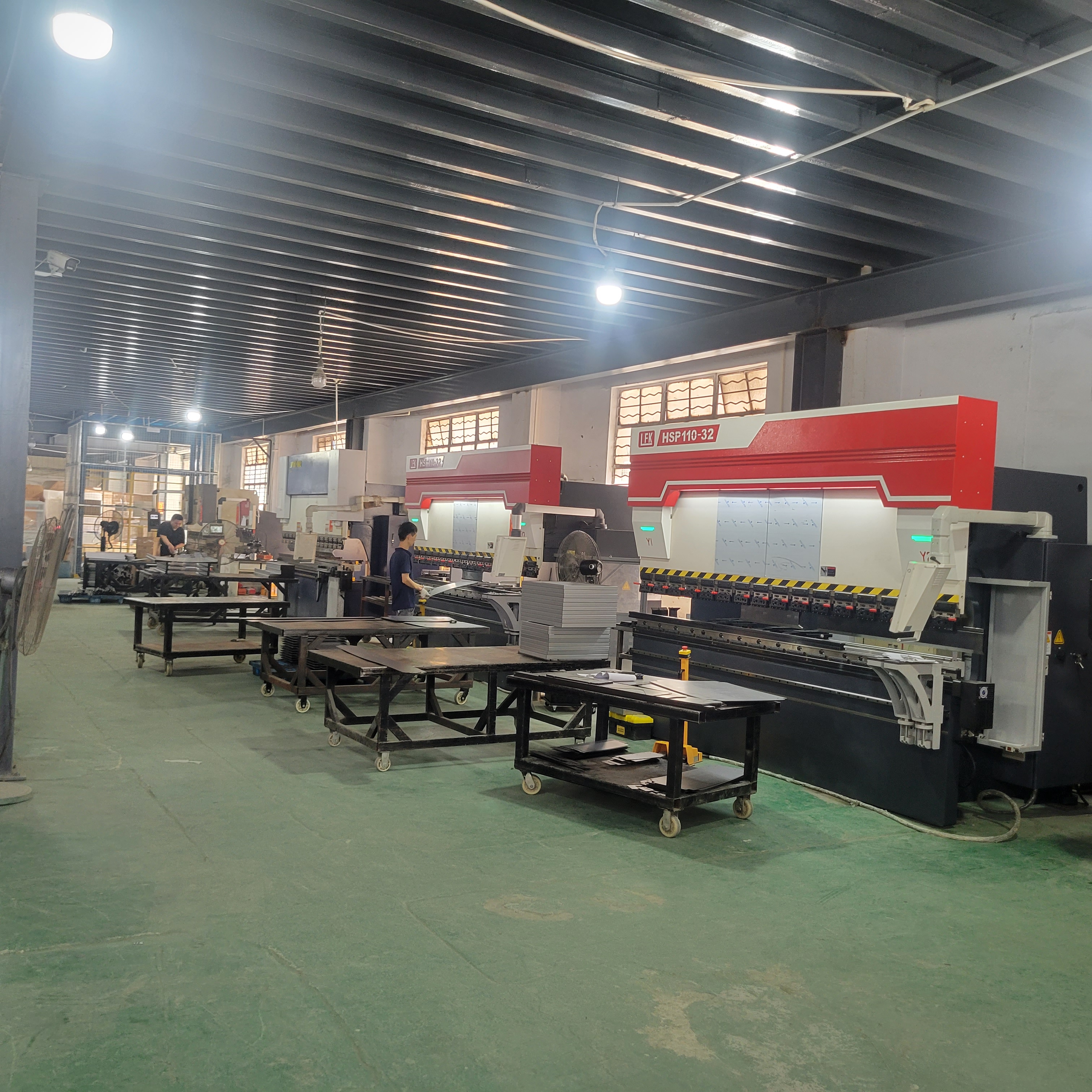
Ever Great operates a 6,000 m² manufacturing base in Foshan with an engineering team focused on laboratory engineering and space planning, and an annual output of 20,000 units against a monthly capacity of 2,000 units. Production covers both OEM and ODM, with customization declared in three areas: technical and specification changes, OEM/white-label supply, and R&D and prototyping. Commercial parameters relevant to a sink-area order are a minimum order quantity of 1 unit, a lead time of 10–30 days, 100% product testing, delivery terms of FOB, CIF, DDP, or EXW, and payment by T/T with 30% advance and 70% balance before delivery. Export markets are the USA, EU, Middle East, and Africa, and export represents around 60% of output. After-sales support is structured as a service level agreement, technical assistance, and spare parts and maintenance, backed by a 1-year comprehensive warranty and lifetime remote or on-site engineering support.
Step-by-Step: A Six-Step Selection Sequence for Sink-Area Benches
Step 1 — Define the wet workflow and the chemical inventory
List what actually happens at the sink: rinsing only, acid digestion, solvent washing, or ashing. The answer determines whether a ceramic worktop is required, whether PP components must extend beyond the sink area, and whether local exhaust at the sink is mandatory or optional.
Step 2 — Fit the bench envelope to the available run
Check the 1500 x 750 x 1500 mm envelope against the planned wall run, service frame position, and aisle clearance. Because the 750 mm depth is shared with other bench platforms such as the C-frame wall bench EG-S0-LB003 (1200/1500/1800 x 750 x 850 mm), sink benches and adjacent dry benches can sit on the same layout grid without custom joinery.
Step 3 — Lock the worktop material and thickness
Decide between 25 mm ceramic and thinner alternatives such as the 12.7 mm phenolic worktop used on the C-frame wall bench and the island bench, or the 20 mm ceramic and epoxy resin options available on the island bench platform. Material and thickness drive both chemical resistance and repairability, and changing this decision after frames are fabricated is expensive.
Step 4 — Configure basins, faucets, and drainage
Confirm the number of basins, the fixture type, and where rinse water goes. The reference configuration is two PP sinks with two three-way gooseneck faucets. Where glassware washing is part of the workflow, pair the bench with dedicated draining storage such as the EG-SS-LB002, a 900 x 500 x 1800 mm 304 stainless steel cabinet with four perforated shelves, a pull-out drip tray, and 5 mm tempered-glass doors.
Step 5 — Integrate exhaust and containment
Fix canopy, duct route, and fan in the same drawing set as the bench, and confirm that the room's make-up air can sustain the airflow being specified. Treat the sink canopy, any adjacent fume hood, and exhausted storage cabinets as one ventilation zone rather than three separate purchases.
Step 6 — Verify documentation, testing, and delivery terms
Ask for the certificate that names the exact model, the pre-shipment test record, and the commercial parameters. On this platform those parameters are MOQ 1 unit, lead time 10–30 days, delivery under FOB, CIF, DDP, or EXW, and payment by T/T with 30% advance and 70% balance before delivery. Acceptance is by pre-shipment test, and quality control is 100% product testing.
Use Cases: Where an Exhaust Washing Bench Fits
Chemical laboratories
In chemical laboratories the sink area handles acid handling, dilution, and immediate rinsing of glassware after digestion or synthesis. A 25 mm ceramic worktop with PP basins and a canopy above the washing position addresses the three dominant exposures in that workflow — chemical attack, thermal shock, and low-level vapour release — at a single station rather than across three separate pieces of furniture.
Pharmaceutical and QC laboratories
QC and pharmaceutical sink areas are dominated by cleaning and rinse protocols, where cross-contamination control matters more than extreme chemical load. Two separate PP basins let dirty and final rinse steps be physically separated, and 304 stainless steel components support the wipe-down routines these laboratories are audited against. The declared application area for the EG-SS-LG002 is exactly this group: chemical, pharmaceutical, and QC laboratories.
Educational, testing, and industrial laboratories
Teaching and industrial testing laboratories generally need a wet station that survives heavy, repetitive use with limited supervision. Ever Great products are exported to the USA, EU, Middle East, and Africa, and the company's delivery footprint covers Mainland China, Hong Kong SAR, Malaysia, India, Australia, Italy, Saudi Arabia, the UAE, and the United States. That geographic spread matters commercially, because sink benches frequently ship as KD assemblies and have to be installed on site with limited local labour — which is why pre-assembly verification, labelled hardware, and remote installation guidance form part of the delivery package.
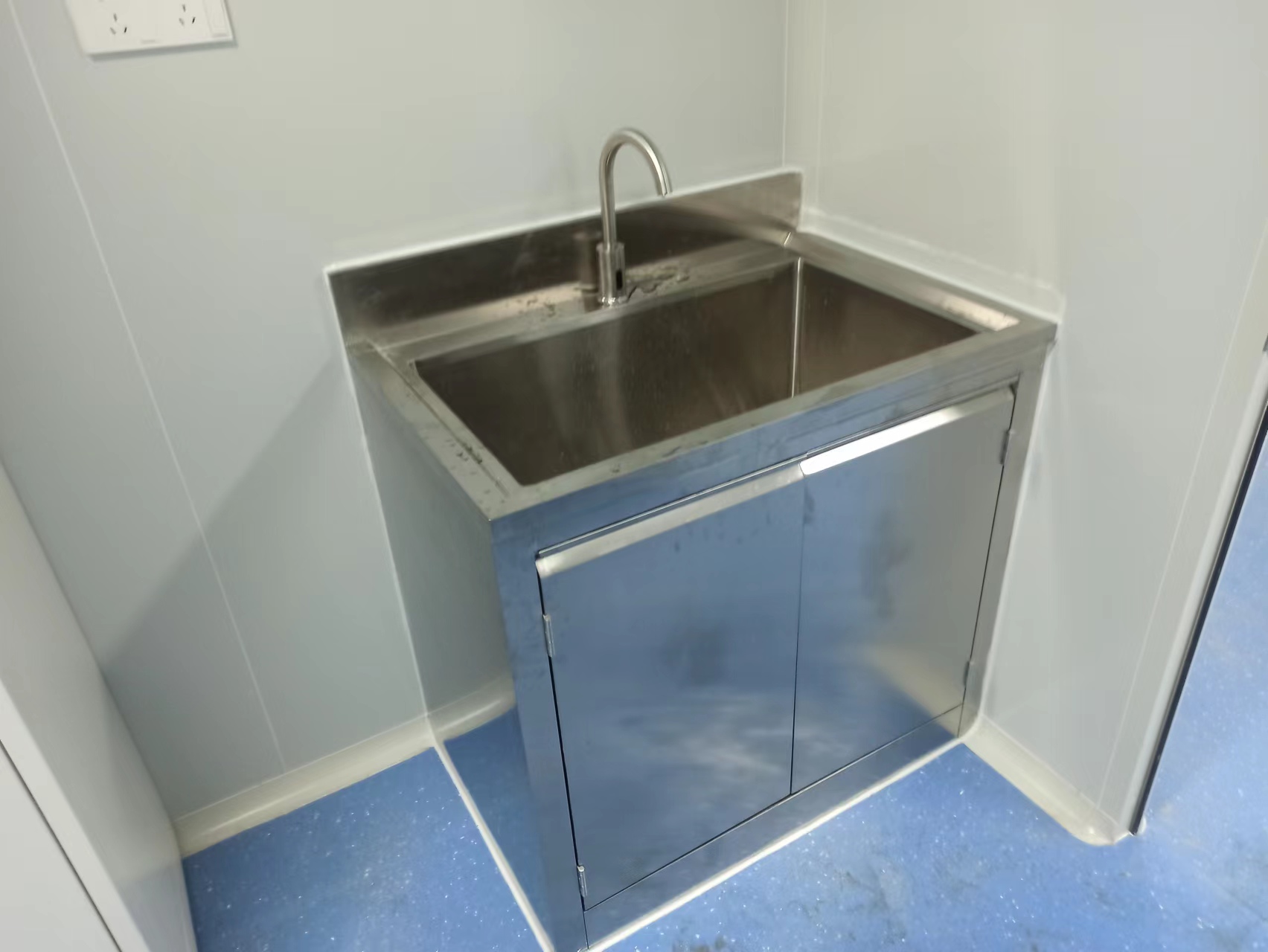
Comparison Table: Sink-Area Specifications at a Glance
The tables below summarise the material and equipment facts referenced in this guide. All model numbers, dimensions, and thicknesses are taken from the manufacturer's published product data.
Table 1 — Worktop and wet-zone materials across the referenced platforms
| Material and specification | Referenced platform | Where it fits around a sink area |
|---|---|---|
| 25 mm ceramic worktop | EG-SS-LG002 exhaust washing bench | Primary wet surface for washing and rinsing; thickest worktop option in the reference range |
| 20 mm ceramic worktop (option) | EG-S0-CB005 island laboratory bench | Heavy-duty central station where a wet position is added to a larger run |
| 12.7 mm phenolic worktop | EG-S0-LB003 C-frame wall bench; EG-S0-CB005 island bench | General chemistry, QC, and physical testing benches adjacent to, but not inside, the wet zone |
| Epoxy resin worktop (option) | EG-S0-CB005 island laboratory bench | Alternative heavy chemical exposure option on the island platform |
| Full steel and 304 stainless steel | EG-SS-LG002; EG-SS-LB002 draining cabinet (1.0 mm 304 stainless steel) | Structural frame and cleanable components that must tolerate permanent humidity |
| PP sink and PP sheet | EG-SS-LG002 (PP sinks); EG-PP-FH (PP ≥8.0 mm); EG-PP-CB003 (8.0 mm PP sheet) | Liquid-contact basins and acid/alkali storage where metal must be avoided |
Table 2 — Equipment typically specified with a sink-area washing bench
| Model | Key specification | Function beside the washing bench |
|---|---|---|
| EG-SS-LG002 | 1500 x 750 x 1500 mm; 25 mm ceramic worktop; two PP sinks; two three-way gooseneck faucets | Wet washing station beneath a canopy |
| EG-SS-LB002 | 900 x 500 x 1800 mm; 1.0 mm 304 stainless steel; four perforated shelves; pull-out drip tray; 5 mm tempered-glass doors | Glassware draining and drying immediately after washing |
| EG-PP-CB003 | 900 x 450 x 1800 mm; 8.0 mm PP sheet; three adjustable spill-containment shelves; bottom sump; Ø110 mm exhaust port | Corrosive acid and alkali storage close to the wet zone |
| EG-S0-LB001 | 900 x 500 x 1800 mm; double-wall steel; four adjustable shelves; Ø110/150 mm exhaust connection | Vented reagent and chemical storage on the same run |
| EG-PP-FH | 1200/1500/1800 x 850 x 2350 mm; PP ≥8.0 mm; face velocity 0.3–0.6 m/s; three-stage baffle | Acid and alkali work adjacent to the sink position |
| Orion-TS / Orion-LD | 1500/1800 x 900 x 2400 mm; nominal face velocity 0.3 m/s; Ø250/315 mm PP exhaust canopy | Main containment hood for the chemistry workflow |
FAQ: Sink-Area Exhaust Washing Benches
1. Does the EG-SS-LG002 exhaust washing bench come with compliance documentation?
Yes, at both company and product level. Ever Great holds a RoHS Attestation of Conformity, certificate TH2310049-C02-C01, issued on 2023-10-13 by Shenzhen Tian Hai Test Technology Co., Ltd. under (EU) 2017/2102, valid until 2028-10-13, and the EG-SS-LG002 appears in that certificate's related product list. Company-level management systems are ISO 9001, ISO 14001, and ISO 45001. Ventilation products such as high-performance laboratory fume hoods are tested against EN 14175 and ASHRAE 110 benchmarks, with third-party reports from inspection bodies such as SGS. Because certificates are issued per scope, confirm at quotation stage which document covers the exact model and configuration being ordered.
2. Can the bench be customised for a specific sink layout or utility plan?
Yes. The EG-SS-LG002 baseline is 1500 x 750 x 1500 mm with a 25 mm ceramic worktop, two PP sinks, and two three-way gooseneck faucets, and Ever Great provides both OEM and ODM production services. Declared customization covers technical and specification changes, OEM/white-label supply, and R&D and prototyping. The minimum order quantity is 1 unit and the production lead time is 10–30 days, so a modified sink configuration can be produced and tested as a discrete order rather than requiring a large batch commitment.
3. Who manufactures OEM custom fume hoods to match this kind of sink-area bench?
Guangdong Ever Great Laboratory Equipment Co., Ltd. provides OEM and ODM production from a 6,000 m² manufacturing base in Foshan, with a monthly capacity of 2,000 units and customization covering technical and specification changes, white-label supply, and prototyping. Its ventilation range includes the polypropylene fume hood EG-PP-FH at 1200/1500/1800 x 850 x 2350 mm with PP sheet of 8.0 mm or more, a face velocity of 0.3–0.6 m/s and a three-stage baffle, and the narrow-frame Orion benchtop and walk-in models at 1500/1800 x 900 x 2400 mm with a nominal face velocity of 0.3 m/s and a Ø250/315 mm PP exhaust canopy. Fume hoods are tested against EN 14175 and ASHRAE 110 benchmarks with third-party SGS reports, exports go to the USA, EU, Middle East, and Africa, and the minimum order quantity is 1 unit with a 10–30 day lead time.
4. What drives the cost of an exhaust washing bench?
Cost is driven by specification choices rather than by a single line item: the worktop material and thickness (25 mm ceramic versus 12.7 mm phenolic versus epoxy resin options on other platforms), the number and material of basins, the faucet and fixture type such as three-way gooseneck faucets, the extent of stainless steel in the structure, and how the canopy and ducting are integrated with the room's exhaust system. Order quantity and delivery term also affect the final figure, since delivery can be arranged under FOB, CIF, DDP, or EXW. Published prices are not available; the reliable path is to fix the specification first, then request a quotation for that exact configuration. Commercial terms on this platform are a minimum order quantity of 1 unit and payment by T/T with 30% advance and 70% balance before delivery.
5. Can we order a single unit as a sample, and how long does delivery take?
Yes. The minimum order quantity is 1 unit, production lead time is 10–30 days, quality control is 100% product testing, and acceptance is by pre-shipment test, so a single bench can be validated before a wider rollout. To move forward, request a sample or quotation for the EG-SS-LG002 configuration you need, or download the full product catalogue, by contacting Ever Great directly — email qsjiang666@outlook.com, telephone or WhatsApp +86 158-0007-2469, or through evergreatlab.com.
Conclusion
Choosing an exhaust washing bench for a laboratory sink area comes down to four verifiable decisions: the worktop material and thickness, the sink and faucet configuration, the bench envelope, and the exhaust integration. On the EG-SS-LG002, those decisions resolve into a 1500 x 750 x 1500 mm stainless steel canopy sink bench with a 25 mm ceramic worktop, two PP sinks, and two three-way gooseneck faucets, built from full steel, 304 stainless steel, PP, and ceramic, and applied in chemical, pharmaceutical, and QC laboratories. Specifying the bench as part of one ventilation zone — together with the adjacent fume hood, drained glassware storage, and exhausted reagent cabinets — produces a sink area that is defined in the drawing set rather than assembled from separate purchases.
Next step: validate the bench against your sink-area layout
Send your utility plan, chemical inventory, and required basin configuration, and Ever Great will return a specification-matched quotation for the exhaust washing bench and its surrounding equipment. Minimum order quantity is 1 unit, production lead time is 10–30 days, and pre-shipment testing is part of every order.
Download the product catalogue: Ever Great Laboratory Furniture Catalogue
Contact: Jasong — qsjiang666@outlook.com — Tel / WhatsApp +86 158-0007-2469 — evergreatlab.com
Have Questions or Need More Details?
Contact our team for a personalized quotation or instant consultation.
Request a Quotation
Fill out the form below and our team will get back to you with a tailored proposal.
WhatsApp Direct Chat
Prefer to chat in real-time? Message us on WhatsApp for instant assistance & quick answers.
- Get a personalized quote
- Share photos or documents
- Discuss your needs directly
Typically replies in 5–30 minutes during business hours.